
Morning Routines · Ages 2–7 · Independence
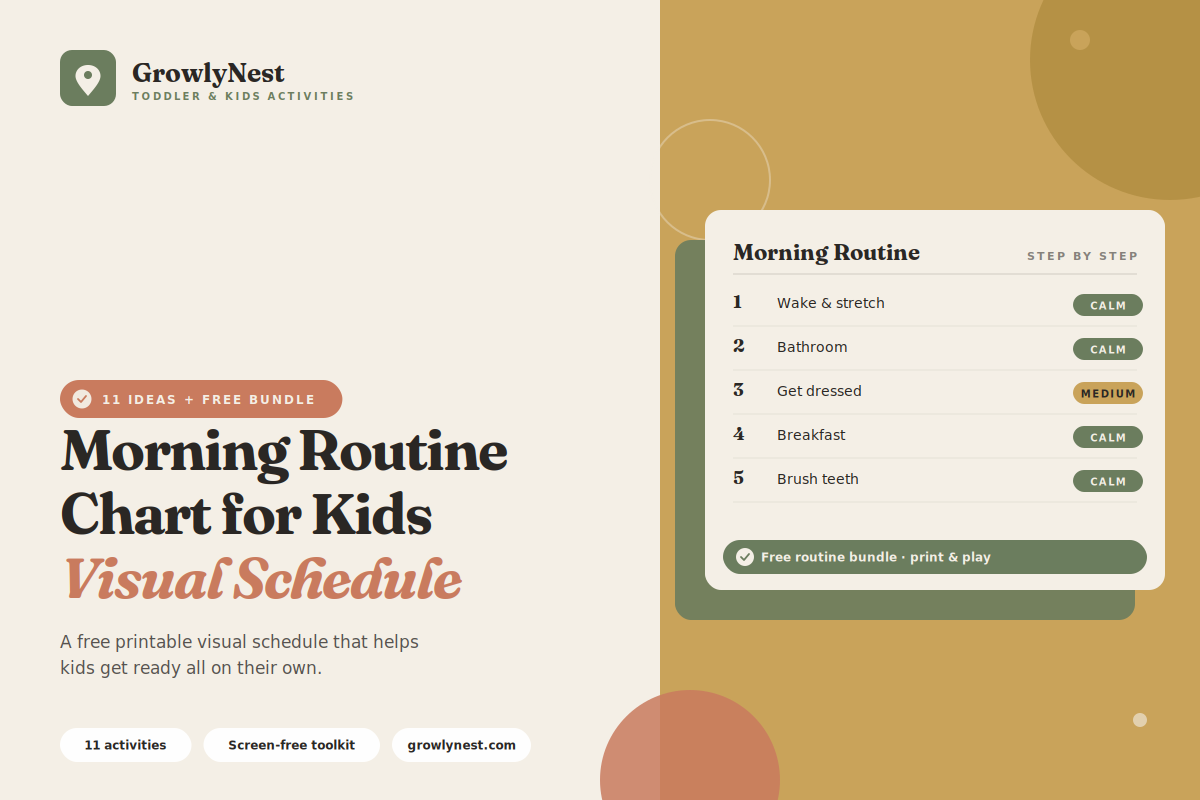
Mornings with young children can feel like herding cats uphill — and the reason is rarely the child being difficult. It's that getting ready is a long, abstract sequence a young child simply can't hold in their head. A morning routine chart fixes exactly that. Here's a complete morning routine you can copy, plus how to get your child to actually use the chart independently.
Why a morning routine chart changes mornings
"Get ready for the day" means nothing to a young child — it's an abstract instruction made up of a dozen separate steps. A printable morning schedule breaks that overwhelming whole into a clear, visual list of one-thing-at-a-time. The child can see exactly what to do, in what order, and tick each step off. That's how a chart turns a chaotic morning into a calm, predictable sequence the child can largely run themselves.
The bigger payoff is independence. When the chart tells your child what's next, you stop being the human alarm clock repeating "now brush your teeth" ten times. The child checks the chart instead of checking with you — and that builds genuine self-reliance and confidence. But the chart only delivers this if it's used well, which is the part the strategies below cover.
Free routine chart download
Get the Free Complete Kids Routine Chart Bundle
Includes the guide parents really need — how to get kids to actually follow the chart — plus morning, bedtime, after-school and chore charts, a routine builder worksheet to design your routine first, blank customisable versions, pre-reader picture cards, and travel and weekend troubleshooting.
Download the Free Routine Bundle →A sample morning routine for kids
Here is a clear, copyable morning sequence. Adjust the steps to fit your family, but keep the same order every day so it becomes automatic.
01. Wake up and stretch
Open the curtains and let your child wake gently with a stretch and a quick cuddle. A calm, connected start makes everything that follows easier.
02. Use the bathroom and wash hands
The first practical step — toilet, then wash hands. Putting it first creates a clean, natural starting point for the routine.
03. Get dressed
Lay out clothes the night before so this step is quick and free of decisions. Letting your child dress themselves, even slowly, builds real independence.
04. Eat breakfast
A calm, unhurried breakfast. Keeping it at the same point each morning anchors the routine and makes sure your child starts the day properly fuelled.
05. Brush teeth and hair
Grooming comes after breakfast so teeth are cleaned last. Pairing teeth and hair into one step keeps the routine simple.
06. Pack the bag and get shoes on
Gather everything needed for the day and put shoes on. For school-age children, packing the bag the night before makes this step almost effortless.
07. Free time until it's time to leave
Build in a small buffer of free play or a book as the final step. It gives a clear, motivating finish line and stops the morning feeling like one long rush.
Struggling to get your child to follow the chart?
A chart on the wall is the easy part — getting kids to actually follow it is the real struggle. The free Complete Kids Routine Chart Bundle includes the step-by-step guide for exactly that, plus a routine builder worksheet, ready-made charts, pre-reader picture cards, and troubleshooting for travel and weekends.
Get the Free Routine BundleHow to get your child to follow the morning chart
A morning chart only works if your child genuinely uses it. These four strategies make that happen.
08. Build the chart with your child
Let your child help choose the steps and the pictures. Ownership is the single biggest factor in whether a child will actually follow a chart.
09. Point to the chart instead of nagging
When your child stalls, don't list instructions — say "check your chart, what's next?" The chart becomes the authority, and your child gets to be independent rather than nagged.
10. Practise at a calm time first
Walk through the chart together at the weekend or in a relaxed moment, not in the middle of a stressful school morning. Your child needs to know how the chart works before relying on it.
11. Prepare the night before
Lay out clothes, pack bags, and set out breakfast things the evening before. A calm morning depends as much on the night before as on the chart itself.
Tips for smoother mornings
1. Wake up before your children
Even fifteen minutes to yourself before the household wakes makes you calmer and more patient — and your calm sets the tone for the whole morning.
2. Use pictures, not words
For pre-readers, a picture for each step is essential. Even for early readers, clear images make the chart faster to follow at a glance.
3. Keep the steps few and clear
A morning chart with five to eight steps works; one with fifteen overwhelms. Group small tasks together and keep it simple.
4. Let your child move a marker
Letting your child tick off or move a marker for each completed step makes the routine active and satisfying — and shows them their own progress.
Frequently asked questions
What age should a child start a morning routine chart?
Children from around 2 to 3 years can follow a simple picture-based morning chart, growing into more steps and independence through the preschool and early school years.
My child gets distracted halfway through the routine. What helps?
Getting distracted is normal. Gently redirect to the chart — "what does your chart say is next?" — rather than issuing a new instruction. A visible chart at their eye level helps them find their way back on their own.
Should I include times on the morning chart?
For younger children, a clear order of steps works better than set times. For school-age children, you can add a target time for the final step or for leaving the house, but keep the rest sequence-based.
How long until the morning routine becomes automatic?
Most children need one to two weeks of consistent use before a morning routine feels natural. Stay calm and consistent through the settling-in period.
My child can't read yet. Will a chart still work?
Yes — a picture-based chart is actually ideal for pre-readers. Clear images for each step let a non-reading child follow the routine completely independently.
The Complete Kids Routine Chart Bundle
A routine that actually sticks
Everything in one free download: the guide to getting kids to actually follow the chart, morning, bedtime, after-school and chore charts, a routine builder worksheet to design your routine first, blank customisable versions, pre-reader picture cards, and troubleshooting for travel and weekends.
Download the Free Routine Bundle →Free forever · No spam · Unsubscribe any time
From the GrowlyNest family — helping you build calm, predictable routines your children genuinely follow.
You're getting — completely free
The Complete Kids Routine Chart Bundle
Here's how to get it
It arrives in 1–2 minutes — check your inbox now.
If you don't see the "Gift File" check your Promotions or Spam folder. Drag it to your main inbox so future emails reach you.
Loading Viewer...