
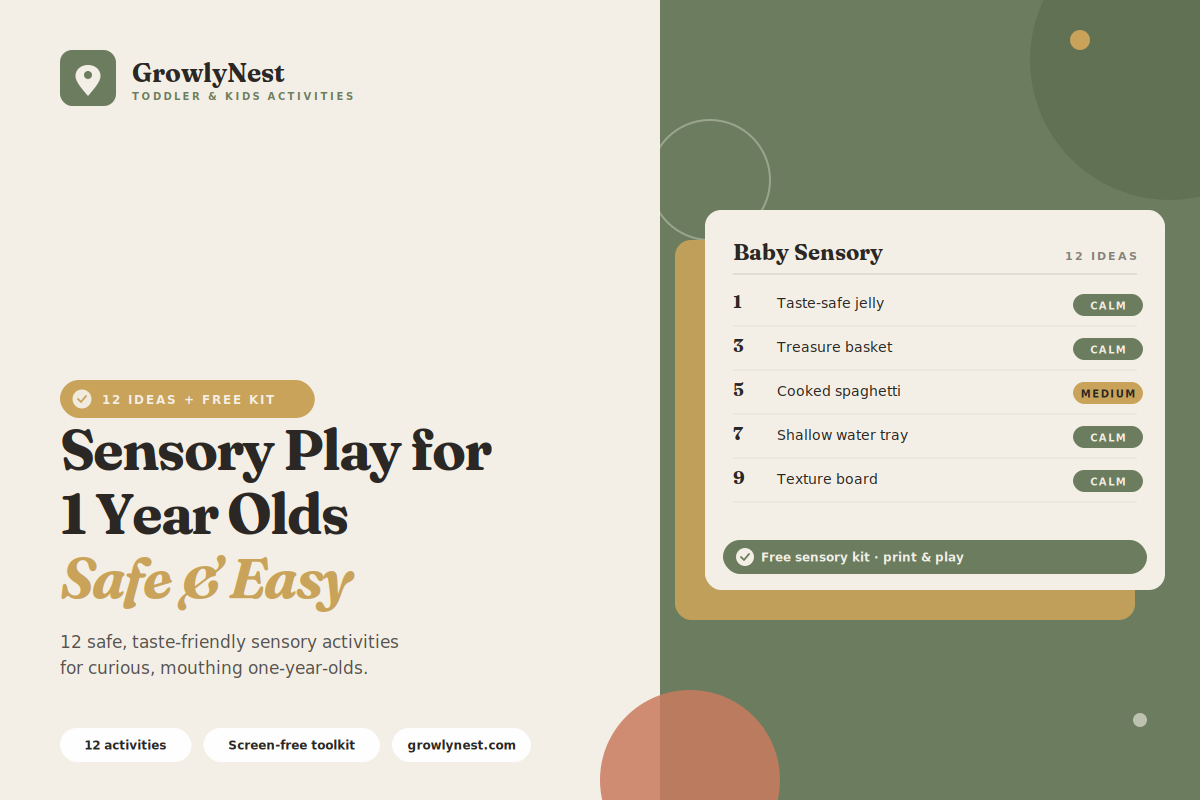
Baby Sensory · Age 1 · Safe Exploration
One-year-olds are wired to explore — and they do it with their whole bodies, especially their hands and mouths. Sensory play for 1 year olds feeds that drive perfectly, but at this age safety comes first. Here are 12 safe, baby sensory activities that support your one-year-old's development, every one chosen with mouthing and supervision in mind.
Why sensory play matters at age one
At twelve to eighteen months, your child's brain is forming connections at an extraordinary rate, and they build that brain through their senses. Touching different textures, feeling temperatures, and exploring how things move all create the neural wiring behind later thinking, language, and movement. Sensory play isn't an extra at this age — it's how a one-year-old learns.
It also builds the practical skills of the first years: the grasp and release that becomes the pincer grip, the hand-eye coordination behind feeding and stacking, and the early language that grows as you narrate what your baby touches. The key at this age is choosing materials that are safe for a child who will absolutely put everything in their mouth.
Free sensory play download
Get the Free Sensory Play Starter Kit
A real parent guide that tackles the mess head-on, 20 sensory bin recipe cards with low / medium / full mess ratings, a “sensory play from what’s in your cupboard” finder, troubleshooting for fussy and mess-averse toddlers, taste-safe recipes for the youngest, and a seasonal sensory planner.
Download the Free Sensory Kit →Taste-safe sensory play
At one, assume everything goes in the mouth — so these activities all use food-safe materials.
01. Taste-safe jelly dig
Make a tray of plain jelly (gelatin) and press in large taste-safe objects like big fruit pieces or chunky toys. Your baby squishes, pokes, and explores the wobble — a captivating texture that's completely safe to mouth.
02. Cooked spaghetti play
Cook spaghetti, cool it fully, and toss it with a little oil. The slippery, drapey strands are a wonderful, safe-to-taste texture for little hands to grab and squish.
03. Edible yoghurt paint
Stir a drop of food colouring into plain yoghurt and let your baby finger-paint on the highchair tray. Bright, cool, sensory-rich, and safe if it ends up in the mouth.
04. Oat sensory tub
A shallow tub of dry porridge oats with cups and scoops. Oats are soft, safe to taste, and easy to sweep up — a gentle first "sensory bin."
05. Banana or avocado mush play
On the highchair tray, let your baby squish and smear soft banana or avocado. It doubles as a relaxed, sensory-led approach to self-feeding.
Texture and discovery play
06. Treasure basket
Fill a basket with safe everyday objects of varied textures and weights — a wooden spoon, a silicone whisk, a fabric scrap, a large smooth pebble too big to swallow. Your baby explores each one freely, building curiosity and sensory vocabulary.
07. Texture board
Glue squares of different materials — corduroy, bubble wrap, foil, felt, sponge — onto a sturdy board for your baby to stroke and pat. A simple, mess-free way to introduce many textures at once.
08. Crinkle and sound exploration
Offer safe items that crinkle, rattle, and rustle — a clean foil sheet, a sealed bottle with rice inside, a crinkly fabric book. Cause-and-effect and sound discovery in one.
09. Ribbon and fabric pull-box
Cut a hole in a box lid and thread through scarves and ribbons for your baby to pull out. The endless pulling builds grip strength and motor planning.
Worried about the mess?
Mess is the number one reason parents skip sensory play. The free Sensory Play Starter Kit tackles it head-on — with 20 sensory bin recipe cards rated low, medium, or full mess, and real troubleshooting for “my child eats everything” and “my child hates getting messy.”
Get the Free Sensory KitGentle water and movement play
10. Shallow water tray
A tray with a centimetre or two of warm water and a few cups, always with you within arm's reach. Splashing and patting the water is a classic, joyful first sensory experience.
11. Sponge squeeze
A wet sponge in a shallow tub for your baby to pat, squeeze, and watch drip. Squeezing builds the hand muscles behind later skills.
12. Ice cube discovery
Offer one large ice cube (too big to be a choking risk) on the highchair tray, closely supervised. The cold, the slipperiness, and the slow melt are fascinating — and a first lesson in temperature.
How to keep sensory play safe at age one
1. Assume everything goes in the mouth
At one, mouthing is normal, healthy exploration. Choose only taste-safe materials, and keep anything small enough to be a choking hazard well out of reach.
2. Stay within arm's reach at all times
One-year-olds need constant, hands-on supervision during sensory play — especially with any water, however shallow. Never step away mid-activity.
3. Keep it short and follow their cues
A one-year-old's focus is brief — five to ten minutes is typical. When they turn away or start throwing materials, the activity is done; pack it away cheerfully.
4. Narrate everything
Talk through what your baby is touching — "cold," "soft," "squishy," "all gone." This running commentary is a powerful boost to early language.
Frequently asked questions
Is one too young for sensory play?
Not at all — one is a wonderful age for it. You simply choose taste-safe materials and supervise hands-on, since a one-year-old explores everything by mouth as well as by hand.
What sensory materials are safe for a 1 year old?
Taste-safe options are best: cooked pasta, oats, plain yoghurt, jelly, soft fruit, and large objects that can't be swallowed. Avoid dry rice and beans, small parts, and water beads, all of which are choking or aspiration hazards at this age.
How long should a 1 year old do sensory play?
Around five to ten minutes is typical. Babies explore in short, frequent bursts, so brief, repeated sessions work better than one long one.
My baby just eats the sensory material. Is that a problem?
It's completely normal — tasting is part of how a one-year-old explores. As long as the material is taste-safe and you're supervising closely, eating a little is fine. The exploring still has real value.
What if my baby seems unsure about a texture?
That's common and fine. Let your baby watch or touch with one finger, never force it, and offer it again another day. Comfort and choice matter more than completing the activity.
The Sensory Play Starter Kit
Sensory play, minus the mess stress
Everything in one free download: a real parent guide to handling the mess, 20 sensory bin recipe cards with mess-level ratings, a cupboard-finder for instant ideas, troubleshooting for “eats everything” and “hates getting messy,” taste-safe recipes for babies, and a seasonal sensory planner.
Download the Free Sensory Kit →Free forever · No spam · Unsubscribe any time
From the GrowlyNest family — helping you raise curious, confident toddlers through hands-on play.
You're getting — completely free
Free Sensory Play Starter Kit
Here's how to get it
It arrives in 1–2 minutes — check your inbox now.
If you don't see the "Gift File" check your Promotions or Spam folder. Drag it to your main inbox so future emails reach you.
Loading Viewer...