
Early Learning · Ages 2–4 · Shapes
Shapes are everywhere in a toddler's world — the round clock, the square window, the triangle of toast. Learning them is one of the first big steps in early maths and visual thinking. Here's how to teach shape recognition through genuine play, plus how to use shape worksheets for toddlers without turning learning into drilling.
Why shapes matter more than they look
Recognising shapes is an early-maths and pre-reading skill rolled into one. Spotting that a circle is different from a square is the same visual discrimination a child will later use to tell a 'b' from a 'd.' Shapes also build the vocabulary toddlers need to describe the world.
Toddlers learn shapes best by handling them, not by labelling them on a page. The most effective approach is hands-on: sorting, building, hunting, and matching real shapes. A shape worksheet is useful as one playful piece of that picture — a tracing game or a sorting mat — never the whole lesson.
Free printable download
Get the Free Ultimate Toddler Starter Pack
A short guide on how toddlers actually learn through play, plus colouring pages, tracing sheets and matching games, a no-prep activity menu, a weekly planner, and a bonus “I did it!” progress chart — all free.
Download the Free Starter Pack →Hands-on shape play
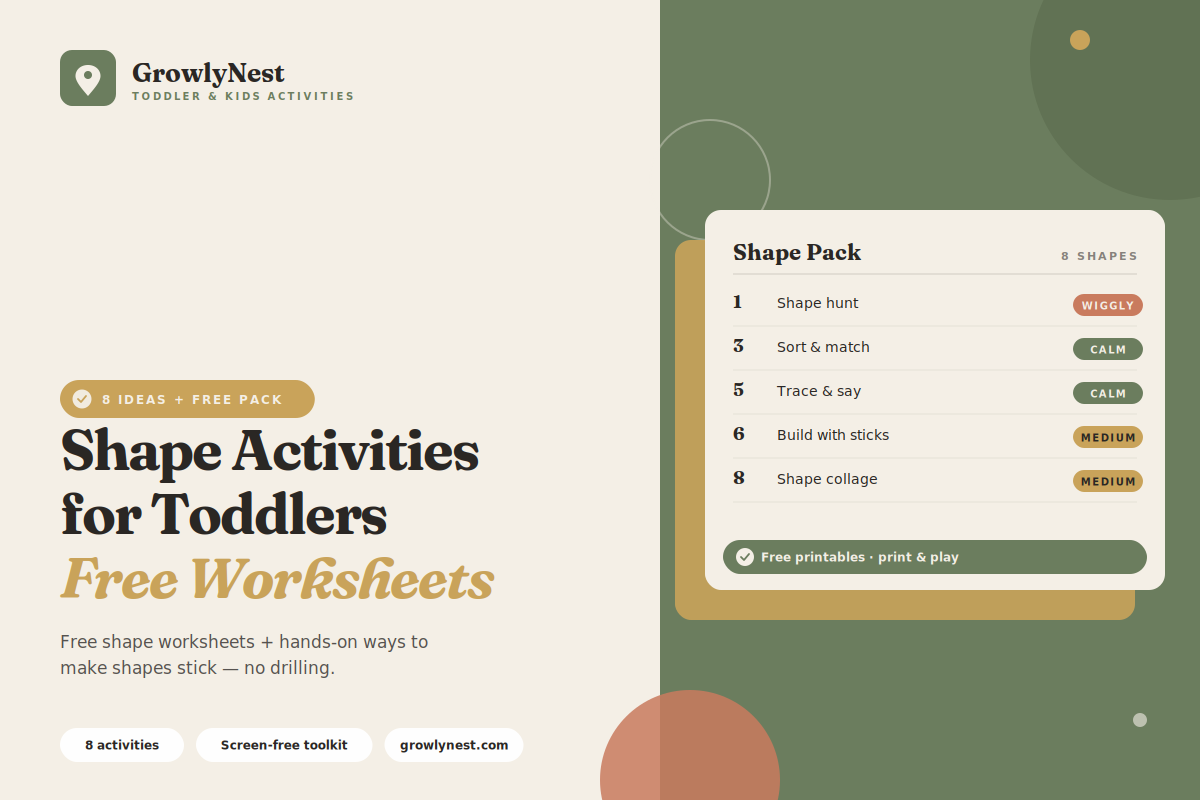
01. Shape hunt
Walk around the house and garden naming shapes — the round plate, the rectangular door. Shapes are genuinely everywhere.
02. Sort and match
Sort blocks or printable shape cards into groups. Sorting is the heart of early shape learning.
03. Build with shapes
Use sticks, blocks, or playdough to construct shapes. Making a triangle teaches it better than naming one.
04. Shape collage
Cut out paper shapes and glue them into pictures — a house from a square and triangle, a face from circles.
05. Shape stamping
Dip blocks or sponges cut into shapes in paint and stamp patterns.
Using shape worksheets the playful way
06. Trace and say
Trace each shape with a finger and name it aloud. Multisensory and pressure-free.
07. Find and cover
Cover shapes on a worksheet with matching objects — buttons on circles, blocks on squares.
08. Colour by shape
Colour all the circles red, all the squares blue. Recognition practice disguised as colouring.
09. Match the real object
Place a real object on the worksheet shape it matches — a coin on the circle, a cracker on the square.
10. Laminate and reuse
A laminated shape sheet becomes a dry-wipe game your toddler can repeat.
Not sure printables count as real play?
The free Ultimate Toddler Starter Pack includes a short guide — How Toddlers Actually Learn Through Play — plus a no-prep activity menu that shows you how to turn every printable into hands-on, playful learning.
Get the Free Starter PackShape learning around the house
11. Mealtime shapes
Cut toast and sandwiches into shapes and name them as you eat.
12. Shape sorter toys
Classic shape-sorter toys build recognition and problem-solving together.
13. Tidy-up sorting
Sort toys into shaped containers as you tidy — learning folded into routine.
14. Shapes in books
Point out shapes in picture books as you read together.
How to make shape learning stick
1. Start with circle, square, triangle
Master the three basics first before moving to rectangles, stars, and beyond.
2. Name shapes in real life
The strongest learning happens off the page — pointing out shapes in the everyday world.
3. Keep it light and playful
Short, game-based bursts beat sit-down worksheet sessions every time.
4. Repeat often
Toddlers learn through repetition. Revisit the same shapes across lots of different activities.
Frequently asked questions
What age should a toddler know their shapes?
Many toddlers begin recognising basic shapes around 2 to 3 years, with more shapes following by 3 to 4. As always, follow your child's pace.
Are shape worksheets too advanced for toddlers?
Used as drilling, yes. Used as tracing games, sorting mats, and colour-by-shape activities, they suit toddlers well. The free Starter Pack guide shows how.
My toddler mixes up squares and rectangles. Is that normal?
Completely normal — they're visually similar. Keep playing with both and the distinction comes with time and repetition.
How long should shape activities last?
Short bursts of 5–15 minutes are ideal. Stop while your toddler is still interested.
Where can I get the shape worksheets?
Printable shape worksheets and matching games are included in the free Ultimate Toddler Starter Pack.
The Ultimate Toddler Starter Pack
Playful learning, not a pile of worksheets
Everything in one free download: the “How Toddlers Learn Through Play” guide, colouring pages, tracing sheets and matching games, a no-prep activity menu, a weekly activity planner, and a bonus “I did it!” progress chart.
Download the Free Starter Pack →Free forever · No spam · Unsubscribe any time
From the GrowlyNest family — helping you raise happy, curious, capable toddlers through play.
You're getting — completely free
The Ultimate Toddler Starter Pack
Here's how to get it
It arrives in 1–2 minutes — check your inbox now.
If you don't see the "Gift File" check your Promotions or Spam folder. Drag it to your main inbox so future emails reach you.
Loading Viewer...