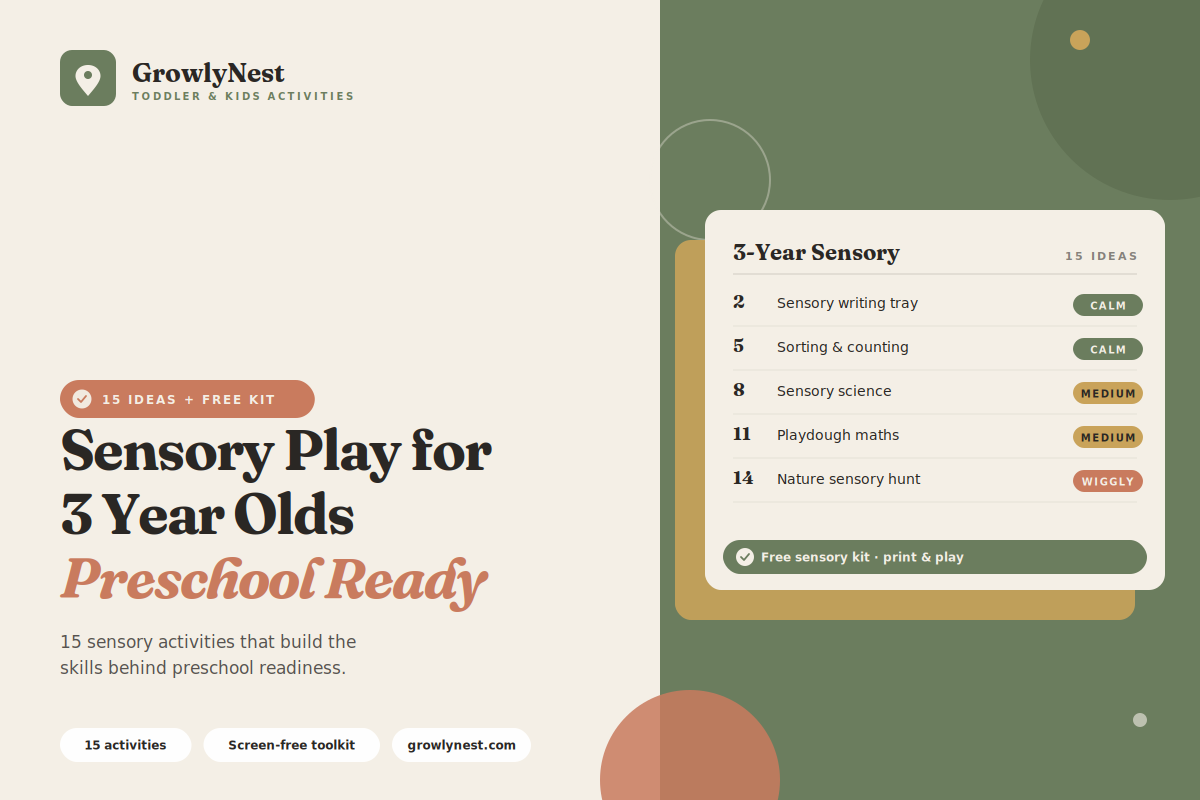
Sensory Play · Age 3 · Preschool Skills
At three, sensory play grows up a little. A three-year-old can follow simple steps, sort and count, tell stories, and stick with an activity longer — which means sensory play can quietly build real preschool readiness skills. Here are 15 sensory play ideas for 3 year olds that develop the hands, the thinking, and the focus a child needs as school approaches.
How sensory play builds school readiness
School readiness isn't about a three-year-old knowing their letters — it's about the underlying skills. Strong hands that can grip a pencil and use scissors. The focus to stick with a task. The ability to follow a couple of instructions, to sort and compare, and to manage emotions and transitions. Sensory play, done with a bit of intention at this age, develops every one of those.
Three-year-olds also learn best when activities have a little structure and a goal woven into open-ended play — sorting by colour, writing in a sensory tray, measuring and pouring. The activities below add that gentle challenge while keeping the hands-on, exploratory nature that makes sensory play so effective and so enjoyable.
Free sensory play download
Get the Free Sensory Play Starter Kit
A real parent guide that tackles the mess head-on, 20 sensory bin recipe cards with low / medium / full mess ratings, a “sensory play from what’s in your cupboard” finder, troubleshooting for fussy and mess-averse toddlers, taste-safe recipes for the youngest, and a seasonal sensory planner.
Download the Free Sensory Kit →Sensory play for pre-writing and fine motor
01. Sensory writing tray
A thin layer of salt, sand, or flour on a dark tray for writing letters, numbers, and their own name with a finger. Mistakes wipe away, so it's pressure-free pre-writing practice.
02. Tweezer transfer challenges
Move pom-poms, beads, or dry pasta between containers using child tweezers or tongs. This builds the precise pincer grip and hand strength behind handwriting.
03. Playdough letters and shapes
Roll dough into snakes and form letters, numbers, and shapes. Constructing a letter makes its shape memorable, and the rolling builds hand strength.
04. Cutting in sensory dough
Snipping playdough "snakes" with child-safe scissors builds the cutting skills a preschooler needs — and is far easier than starting with paper.
05. Threading patterns
Thread beads onto a lace in simple repeating patterns. Fine motor practice and early maths in one calm activity.
Sensory play for thinking and early maths
06. Sorting and counting bin
A sensory bin with objects to dig out, sort into groups, and count. Sorting and counting are foundational maths skills, and the digging keeps it playful.
07. Sensory science experiments
Simple, safe experiments — bicarbonate of soda and vinegar fizzing, colour mixing, ice melting — spark curiosity and early scientific thinking.
08. Measuring and pouring lab
Cups, scales, and jugs with a filler or water, for measuring, comparing, and discovering more, less, full, and empty.
09. Pattern-making tray
A tray of loose parts — buttons, gems, sticks — for building and copying repeating patterns, an important early-maths skill.
10. Estimation jar
A jar of objects to guess the number of, then tip out and count together — playful early number sense.
Worried about the mess?
Mess is the number one reason parents skip sensory play. The free Sensory Play Starter Kit tackles it head-on — with 20 sensory bin recipe cards rated low, medium, or full mess, and real troubleshooting for “my child eats everything” and “my child hates getting messy.”
Get the Free Sensory KitSensory play for language, imagination, and focus
11. Small-world sensory scenes
A themed sensory base — a jungle, a farm, a building site — with figures and props for rich, language-building imaginative play.
12. Story sensory bins
Recreate a favourite story in a sensory bin and retell it together as your child plays — a wonderful boost for language and narrative skills.
13. Nature sensory hunt and sort
Collect natural treasures outdoors, then sort them by type, colour, or size in a tray — observation, vocabulary, and classifying combined.
14. Sensory bin with hidden challenges
Hide letters, numbers, or matching pairs in filler and set a simple find-it task — focus, recall, and early literacy or maths together.
15. Calm-down sensory corner
A quiet spot with a sensory bottle, dough, or a small sand tray that your child can choose when they feel overwhelmed — building the self-regulation skills school will ask for.
How to make sensory play count at age 3
1. Add a gentle goal
Three-year-olds enjoy a little challenge. Adding a simple task — sort these, find the letters, copy this pattern — keeps the play engaging while it builds school-readiness skills.
2. Still let them lead
A goal shouldn't become a worksheet. Offer the challenge, then let your child explore it their own way. Open-ended, child-led play is still where the deepest learning happens.
3. Follow their interests
A dinosaur-obsessed three-year-old will sort, count, and write far longer in a dinosaur-themed activity. Use what your child loves as the doorway to skills.
4. Build in independence
Three-year-olds can manage more setup and cleanup themselves. Letting them help fetch materials and tidy up builds the responsibility and confidence school will expect.
Frequently asked questions
Is my 3 year old too old for sensory play?
Not at all — three is a brilliant age for it. Sensory play simply grows with the child, adding sorting, counting, writing, and storytelling challenges to the open-ended exploration.
How does sensory play help with school readiness?
It builds the underlying skills school needs: strong hands for writing, focus and persistence, the ability to follow instructions, early sorting and counting, and emotional regulation — all through play.
How long should a 3 year old focus on sensory play?
Many three-year-olds can stay engaged for 20–45 minutes, especially with an absorbing, slightly challenging activity. Follow your child's interest and stop when they're genuinely done.
Should I be teaching letters and numbers through sensory play?
You can, playfully — sensory writing trays and hidden-letter hunts are great. But keep it light and game-like; at three, building the underlying skills and a love of learning matters more than formal drilling.
My 3 year old rushes through activities. How do I build focus?
Choose activities with a clear, achievable goal, sit alongside to model staying with it, and keep sessions enjoyable. Focus is a skill that grows with practice and patience.
The Sensory Play Starter Kit
Sensory play, minus the mess stress
Everything in one free download: a real parent guide to handling the mess, 20 sensory bin recipe cards with mess-level ratings, a cupboard-finder for instant ideas, troubleshooting for “eats everything” and “hates getting messy,” taste-safe recipes for babies, and a seasonal sensory planner.
Download the Free Sensory Kit →Free forever · No spam · Unsubscribe any time
From the GrowlyNest family — helping you raise curious, confident toddlers through hands-on play.
You're getting — completely free
Free Sensory Play Starter Kit
Here's how to get it
It arrives in 1–2 minutes — check your inbox now.
If you don't see the "Gift File" check your Promotions or Spam folder. Drag it to your main inbox so future emails reach you.
Loading Viewer...