
Independence · Ages 3–7 · Self-Care
There's a moment every parent looks forward to: when your child can get themselves ready without you steering every single step. A getting ready chart is how you get there. By laying out the self-care steps visually, it hands your child the independence — and you the calmer mornings. Here's a complete getting-ready routine, plus how to teach your child to follow it on their own.
Why a getting ready chart builds independence
"Getting ready" is, to a young child, a vague and overwhelming instruction — a tangle of separate tasks they can't hold in mind or sequence on their own. That's why they rely on you to prompt each step. A getting ready chart dissolves that problem: it breaks the abstract whole into a visible, ordered list of single steps the child can see and follow. The chart becomes the external memory, so the child doesn't need you to be it.
That shift is what builds genuine independence. When a child follows the chart instead of waiting for your reminders, they experience themselves as capable — "I can get ready by myself" — and that confidence spills into other areas. It also ends the exhausting cycle of repeating the same instructions every morning. The chart works, though, only if your child is taught to use it well, which is what the strategies below cover.
Free routine chart download
Get the Free Complete Kids Routine Chart Bundle
Includes the guide parents really need — how to get kids to actually follow the chart — plus morning, bedtime, after-school and chore charts, a routine builder worksheet to design your routine first, blank customisable versions, pre-reader picture cards, and travel and weekend troubleshooting.
Download the Free Routine Bundle →A sample getting ready routine
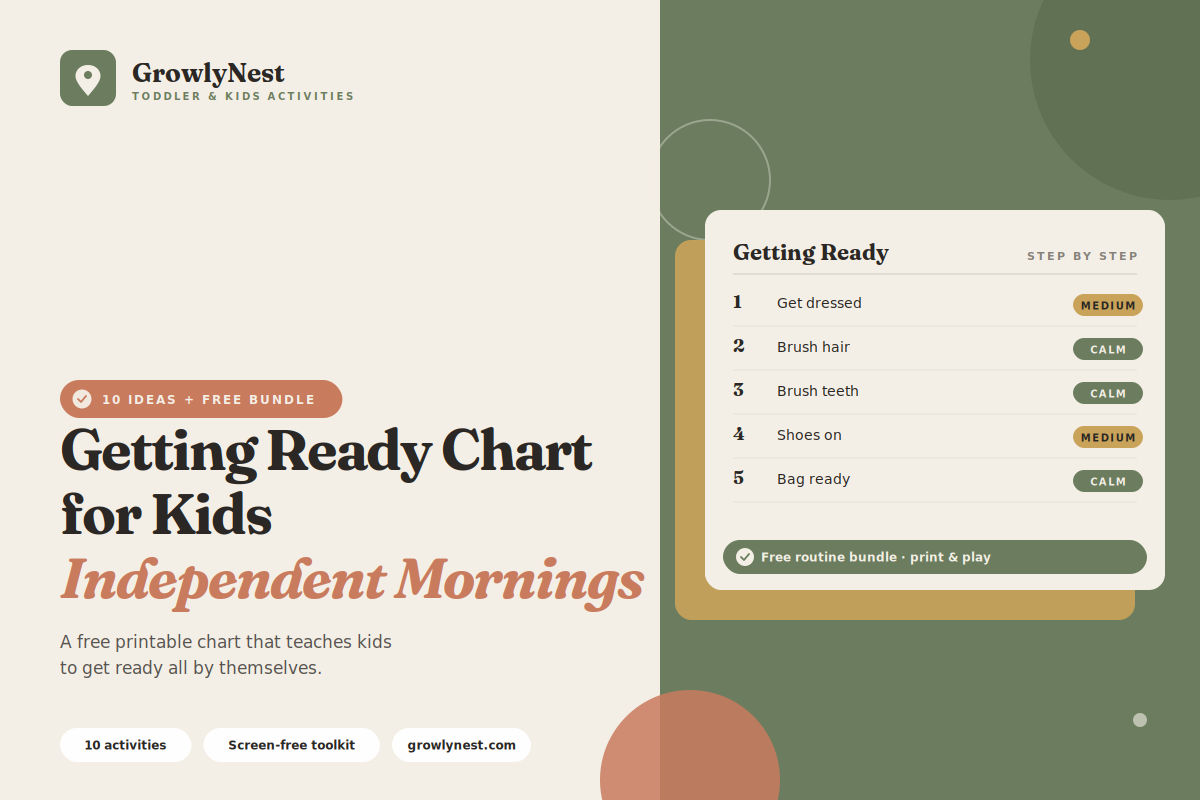
Here is a clear self-care sequence for a child to follow independently. Keep the same order each day so it becomes automatic.
01. Get dressed
Lay clothes out the night before so there are no decisions to make. Letting your child dress themselves, even slowly, is a core independence step — resist stepping in to speed it up.
02. Brush hair
A simple grooming step a child can learn to manage themselves. Keep a brush in an easy-to-reach, consistent spot so your child can do this without help.
03. Brush teeth
Teeth-brushing as its own clear step. Younger children will still need a check or a final brush from you, but they can take ownership of starting it.
04. Wash face and hands
A quick wash to feel fresh and ready. Including it on the chart builds a complete, healthy self-care routine.
05. Put on shoes and socks
Shoes and socks as a distinct step. Keeping them in a consistent place by the door makes this quick and independent.
06. Get bag and coat ready
The final step — gathering everything needed and getting the coat on. Packing the bag the night before makes this an easy, satisfying finish to the routine.
Struggling to get your child to follow the chart?
A chart on the wall is the easy part — getting kids to actually follow it is the real struggle. The free Complete Kids Routine Chart Bundle includes the step-by-step guide for exactly that, plus a routine builder worksheet, ready-made charts, pre-reader picture cards, and troubleshooting for travel and weekends.
Get the Free Routine BundleHow to teach your child to follow the chart
Independence is taught, not assumed. These strategies help your child genuinely run the chart themselves.
07. Teach the chart at a calm time
Walk through the chart together when there's no time pressure — at the weekend, or in a relaxed evening. Your child needs to learn the routine before relying on it in a busy morning.
08. Step back gradually
At first, do the routine alongside your child. Then move to prompting only with the chart — "check what's next" — and finally to letting them run it alone. Withdraw your help in stages.
09. Point to the chart, don't instruct
When your child pauses, resist giving the next instruction. Instead say "what does your chart say?" This keeps the independence with the child and the chart, not with you.
10. Let them track their own progress
Let your child tick off or move a marker for each completed step. Seeing their own progress makes the routine motivating and reinforces that they are doing it themselves.
Tips for raising an independent morning routine
1. Set up the environment for success
Low hooks, an easy-to-reach clothes drawer, shoes by the door — arranging the space so your child can access what they need is half the battle for independence.
2. Allow extra time while they learn
A child doing the routine themselves is slower than you doing it for them, at first. Build in extra time so independence isn't sacrificed to the morning rush.
3. Resist jumping in
When your child is slow or imperfect, the urge to take over is strong. Holding back — and letting them finish the step themselves — is what builds the skill.
4. Praise the independence itself
Notice and name it — "you got completely ready by yourself." Praising the independence, not just the speed, motivates your child to keep owning the routine.
Frequently asked questions
What age can a child get ready independently?
Children can start managing parts of getting ready from around age 3, and many can run most of a getting-ready chart by 5 to 7. Independence builds gradually — expect to step back in stages.
My child is so slow when getting ready themselves. What helps?
Slowness is normal as a child learns. Build in extra time, lay things out the night before, and resist taking over. Speed comes with practice — the independence is worth the early slowness.
Should I still help with getting ready?
Yes, at first — do the routine alongside your child, then gradually withdraw to just prompting with the chart, then to letting them run it alone. Some steps, like a final teeth check, may still need you for a while.
My child won't follow the getting-ready chart. What's wrong?
Often the chart hasn't been taught at a calm time, or the parent is still instructing rather than referring to the chart. Practise the routine when there's no rush, point to the chart instead of giving steps, and make sure your child helped create it.
How do I make mornings less of a rush?
Prepare as much as possible the night before, set up the environment so your child can access what they need, allow extra time, and let the chart — not your reminders — guide the routine. A calm morning starts the evening before.
The Complete Kids Routine Chart Bundle
A routine that actually sticks
Everything in one free download: the guide to getting kids to actually follow the chart, morning, bedtime, after-school and chore charts, a routine builder worksheet to design your routine first, blank customisable versions, pre-reader picture cards, and troubleshooting for travel and weekends.
Download the Free Routine Bundle →Free forever · No spam · Unsubscribe any time
From the GrowlyNest family — helping you build calm, predictable routines your children genuinely follow.
You're getting — completely free
The Complete Kids Routine Chart Bundle
Here's how to get it
It arrives in 1–2 minutes — check your inbox now.
If you don't see the "Gift File" check your Promotions or Spam folder. Drag it to your main inbox so future emails reach you.
Loading Viewer...