On-the-Go Play · Ages 2–4 · Travel-Ready
A toddler busy binder is one of the most useful things you can put together — a folder of reusable, low-mess activities that goes anywhere. Restaurant, car, waiting room, quiet time at home: you simply open the binder. Here's what to put inside, how to use it, and why it works so well for toddlers.
Why a busy binder works so well
A busy binder solves the universal parent problem: needing a toddler to be calmly occupied somewhere there's nothing to do. Because the pages are laminated and reusable — usually with Velcro or dry-wipe — one binder lasts for months and packs flat into any bag.
It also works because the activities are short, self-contained, and pitched right for toddlers: match the colours, count the dots, trace the line, sort the animals. Each page is a small, satisfying challenge. Far from busywork, a good binder builds real skills — matching, counting, fine motor control — while keeping little hands happily occupied.
Free printable download
Get the Free Ultimate Toddler Starter Pack
A short guide on how toddlers actually learn through play, plus colouring pages, tracing sheets and matching games, a no-prep activity menu, a weekly planner, and a bonus “I did it!” progress chart — all free.
Download the Free Starter Pack →What to put in your toddler busy binder
A balanced binder mixes matching, counting, fine motor, and sorting pages.
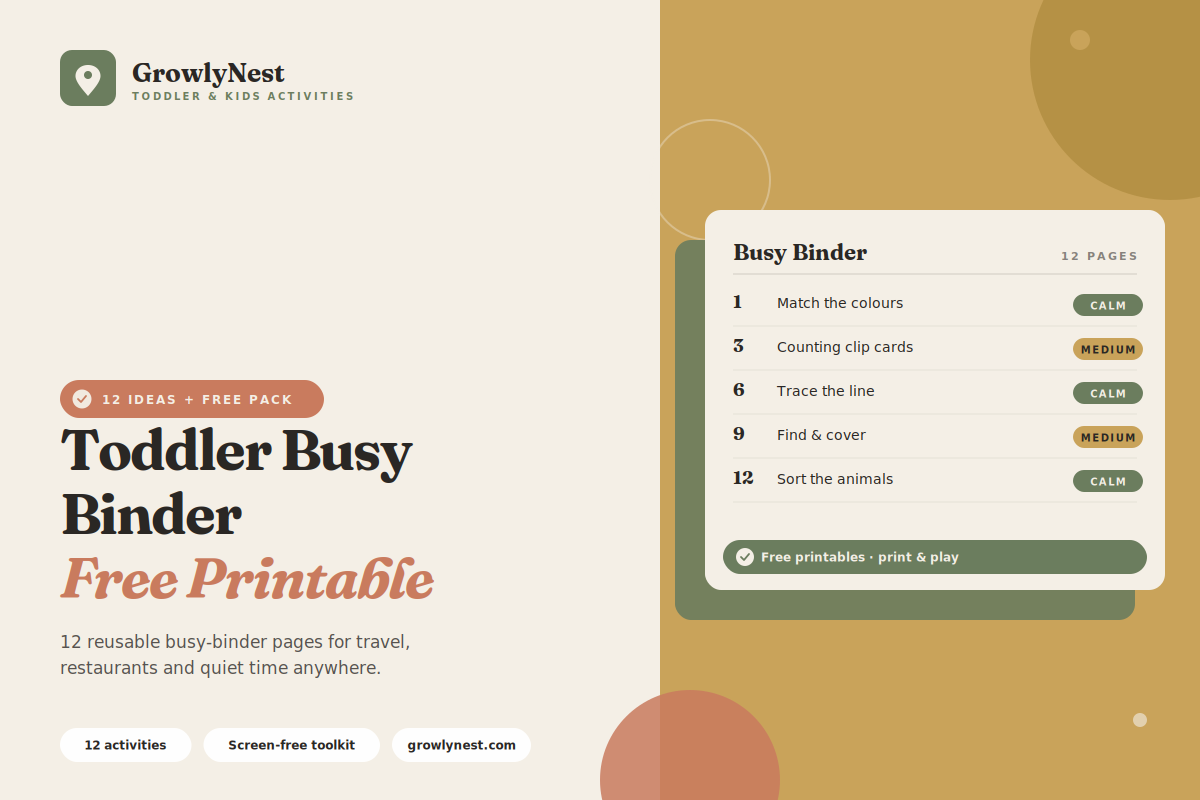
01. Colour matching page
Match Velcro pieces to the right colour spot. Simple, satisfying, and great for younger toddlers.
02. Shape matching page
Match shapes to their outlines — early geometry and visual discrimination.
03. Counting clip cards
Count the objects and clip a peg to the right number. Counting plus a pincer-grip workout.
04. Line tracing page
Trace dotted lines with a dry-wipe crayon — playful pre-writing practice.
05. Animal sorting page
Sort animals by where they live — farm, jungle, ocean. Sorting and vocabulary together.
06. Find-and-cover page
Cover hidden pictures with tokens as you spot them. A focused searching game.
07. Size sorting page
Order objects from smallest to biggest — early maths thinking.
08. Pattern page
Continue a simple pattern with movable pieces — red, blue, red, blue.
How to use the busy binder
09. Keep it for special moments
Reserve the binder for outings and waits rather than everyday play. The novelty keeps it engaging.
10. Start with a few pages
Begin with four or five pages, not twenty. You can always add more as your toddler grows.
11. Sit alongside at first
Show your toddler how each page works the first few times, then let them lead.
12. Refresh the pages
Swap pages in and out every month or so to keep the binder feeling new.
Not sure printables count as real play?
The free Ultimate Toddler Starter Pack includes a short guide — How Toddlers Actually Learn Through Play — plus a no-prep activity menu that shows you how to turn every printable into hands-on, playful learning.
Get the Free Starter PackWhere a busy binder saves the day
13. Restaurants and cafés
A calm, screen-free activity while you wait for food.
14. Car and travel
Compact and contained — perfect for journeys, with no small pieces to lose.
15. Appointments and waiting rooms
Turns an unpredictable wait into peaceful, occupied time.
16. Quiet time at home
A go-to for independent play during the post-lunch lull.
How to make your busy binder last
1. Laminate everything
Lamination makes pages durable and wipe-clean. A laminator pays for itself fast, but dry-wipe wallets also work.
2. Use Velcro dots for movable pieces
Velcro keeps matching and sorting pieces in place and travel-ready.
3. Store loose pieces in a zip pouch
A small pouch clipped inside the binder keeps pieces from going missing.
4. Match pages to your toddler's stage
Start simple and add trickier pages as skills grow. The binder should always feel achievable.
Frequently asked questions
What age is a busy binder best for?
Busy binders suit toddlers from around 2 to 4 years. For younger toddlers, choose simple matching and sorting pages; add tracing and counting as they grow.
Isn't a busy binder just worksheets in a folder?
Not when the pages are interactive — matching, sorting, clipping, tracing. They're hands-on mini-games, not sit-still worksheets. The free Starter Pack guide explains the difference.
Do I need a laminator?
It helps for durability, but it's not essential. Dry-wipe wallets or page protectors work well as a low-cost alternative.
How many pages should a binder have?
Start with four to six. Too many pages overwhelms a toddler — a small, well-chosen set keeps them engaged.
Where can I get the printable busy binder pages?
Printable busy binder pages — matching, tracing, and counting — are included in the free Ultimate Toddler Starter Pack.
The Ultimate Toddler Starter Pack
Playful learning, not a pile of worksheets
Everything in one free download: the “How Toddlers Learn Through Play” guide, colouring pages, tracing sheets and matching games, a no-prep activity menu, a weekly activity planner, and a bonus “I did it!” progress chart.
Download the Free Starter Pack →Free forever · No spam · Unsubscribe any time
From the GrowlyNest family — helping you raise happy, curious, capable toddlers through play.
You're getting — completely free
The Ultimate Toddler Starter Pack
Here's how to get it
It arrives in 1–2 minutes — check your inbox now.
If you don't see the "Gift File" check your Promotions or Spam folder. Drag it to your main inbox so future emails reach you.
Loading Viewer...