
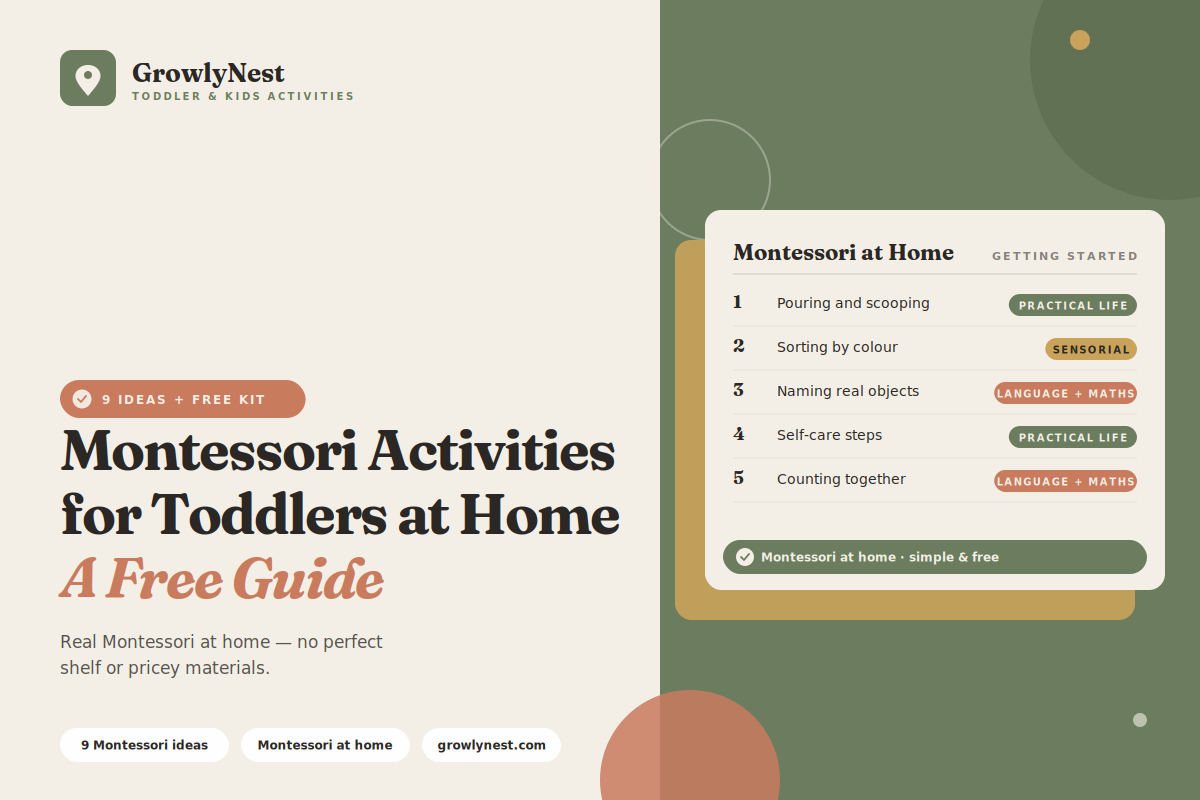
Montessori · At Home · Toddler Activities
If you've spent any time on Pinterest, you've seen them: those flawless, light-filled Montessori playrooms with perfect wooden shelves and beautiful materials. They're lovely — and they put a lot of parents off entirely. Here's the truth: Montessori activities for toddlers at home don't require any of that. This is your real, practical, no-pressure guide to getting started.
What Montessori really is — and what's been keeping you out
Before anything else, it helps to understand what Montessori actually is, because it's widely misunderstood. Montessori is not a brand of wooden toy or a particular shelf. It's an educational approach, developed by Dr Maria Montessori, built on a few simple, powerful ideas: that children are naturally driven to learn; that they learn best by doing, with their hands, with real objects; that they thrive with independence and meaningful work; and that the adult's role is to observe the child, follow their interests, and prepare an environment where they can explore safely and freely. At its heart, Montessori is a respectful, child-led way of being with your toddler. It builds genuine independence, concentration, coordination, and confidence — and the toddler years, when children are bursting to do things "by myself", are the perfect time to begin.
So here is the single biggest barrier, and the one this guide exists to remove: the belief that you need the perfect shelf and expensive materials to "do Montessori". You do not. Montessori is principles, not products. You can offer rich, genuine Montessori activities using a kitchen drawer's worth of bowls, spoons, jugs, and household objects you already own. A "prepared environment" can be one low basket of activities, not a styled playroom. Following the child costs nothing. The families getting the real benefit of Montessori are rarely the ones with the most beautiful shelves — they're the ones who understood the ideas and started small, today, with what they had. That's exactly how this guide will help you begin.
Free Montessori starter kit
Get the Free Montessori-at-Home Starter Kit
Everything you need to start Montessori at home — without the perfect shelf or expensive materials. The kit includes the guide to doing Montessori on a real budget, a plain-English “what is Montessori, really?” primer, DIY tray printables, Montessori shelf labels, a finder by skill area, and an observation and progress tracker.
Download the Free Starter Kit →Simple Montessori activities to start with today
These activities need only everyday household objects — no special materials, no shopping trip. They span the core Montessori areas.
01. Pouring and scooping (practical life)
Set out a small jug of water or a bowl of dried beans and let your toddler pour and scoop between two containers. This classic practical-life activity builds concentration, coordination, and hand control — and toddlers find it genuinely absorbing. Use real, child-sized vessels you already own.
02. Sorting by colour (sensorial)
Give your toddler a mixed bowl of objects — pom-poms, buttons, blocks — and a few cups to sort them into by colour. Sorting builds visual discrimination and early logical thinking, and it's a true sensorial activity made entirely from things in your home.
03. Naming real objects (language)
Gather a small basket of real, familiar objects and name them clearly with your toddler — "this is a spoon, this is a brush." Montessori language work starts with rich, accurate vocabulary built around real things, not screens or flashcards.
04. Self-care steps (practical life)
Let your toddler take on a small piece of caring for themselves — washing hands, putting on shoes, hanging up a coat. Practical-life self-care is core Montessori, building the independence toddlers crave, and it costs nothing to offer.
05. Counting together (early maths)
Count real things throughout the day — steps, snack pieces, toys being tidied. Montessori maths begins with concrete counting of actual objects, making numbers tangible long before any worksheet.
No perfect shelf. No expensive materials. Just start.
The free Montessori-at-Home Starter Kit removes the biggest barrier keeping parents out — the belief that you need a costly set-up. Inside: a “what is Montessori, really?” primer, DIY tray printables, shelf labels, a finder by skill area, and a progress tracker.
Get the Free Starter KitHow to bring Montessori into your home — simply
A few foundational habits matter far more than any material. These are the real heart of Montessori at home.
06. Follow the child
The single most important Montessori principle: observe your toddler and follow their genuine interests. If they're fascinated by water, offer water activities. Following the child means learning is driven by real motivation — and it costs nothing but attention.
07. Prepare a simple environment
A "prepared environment" can be modest: a low shelf or basket with a few activities your toddler can reach and choose independently, and a child-height set-up for everyday tasks. Simplicity is the goal — fewer, accessible things, not a styled room.
08. Offer real, hands-on work
Montessori children use real objects for real purposes — a real little jug, a real cloth, real practical tasks. Hands-on work with genuine materials builds coordination and the satisfying sense of doing something that matters.
09. Step back and let them try
Once you've shown an activity slowly, step back and let your toddler work at it themselves — even slowly and imperfectly. Resisting the urge to take over or correct is how Montessori builds genuine independence and concentration.
Tips for starting Montessori at home
1. Start with what you have
You don't need to buy anything. Bowls, jugs, spoons, and household objects make wonderful Montessori activities — begin today with your own kitchen.
2. Start small
One basket of a few activities is a real Montessori start. Forget the perfect playroom — a simple, doable beginning is what actually lasts.
3. Observe your child
Watch what genuinely fascinates your toddler and follow it. Observation is the most important — and cheapest — Montessori tool you have.
4. Let them do it themselves
Show an activity slowly, then step back. Montessori independence grows when we let toddlers work, imperfectly, on their own.
Frequently asked questions
Do I need expensive materials to do Montessori at home?
No — this is the biggest myth. Montessori is an approach built on principles, not products. You can offer genuine Montessori activities using bowls, jugs, spoons, and household objects you already own. The ideas matter far more than any material.
What is Montessori, really?
Montessori is a child-led educational approach: children are naturally driven to learn, learn best by doing with real objects, and thrive with independence. The adult observes the child, follows their interests, and prepares a simple environment for safe exploration.
What age can toddlers start Montessori activities?
Montessori suits toddlers from around age 1, with activities growing in complexity through to age 4 or 5 and beyond. The toddler years, when children long to do things themselves, are an ideal time to begin. Match activities to your child's stage.
Do I need a special Montessori shelf or playroom?
No. A "prepared environment" can simply be one low basket or shelf with a few activities your toddler can reach and choose. The Pinterest-perfect playroom is not the point — accessibility and simplicity are what matter.
How do I start Montessori at home?
Start small and start today: offer one or two simple activities using household objects, observe what genuinely interests your toddler and follow it, set up a simple accessible space, and show activities slowly before stepping back to let your child work.
The Montessori-at-Home Starter Kit
Start Montessori at home — the simple, affordable way
Everything in one free download: the guide to Montessori at home without the perfect shelf or expensive materials, a “what is Montessori, really?” primer, DIY tray printables, Montessori shelf labels, a finder by skill area (practical life, sensorial, language, maths), and an observation and progress tracker. Start today, with what you already have.
Download the Free Starter Kit →Free forever · No spam · Unsubscribe any time
From the GrowlyNest family — helping you bring calm, capable, child-led learning into your home, no perfect shelf required.
You're getting — completely free
The Montessori-at-Home Starter Kit
Here's how to get it
It arrives in 1–2 minutes — check your inbox now.
If you don't see the "Gift File" check your Promotions or Spam folder. Drag it to your main inbox so future emails reach you.
Loading Viewer...