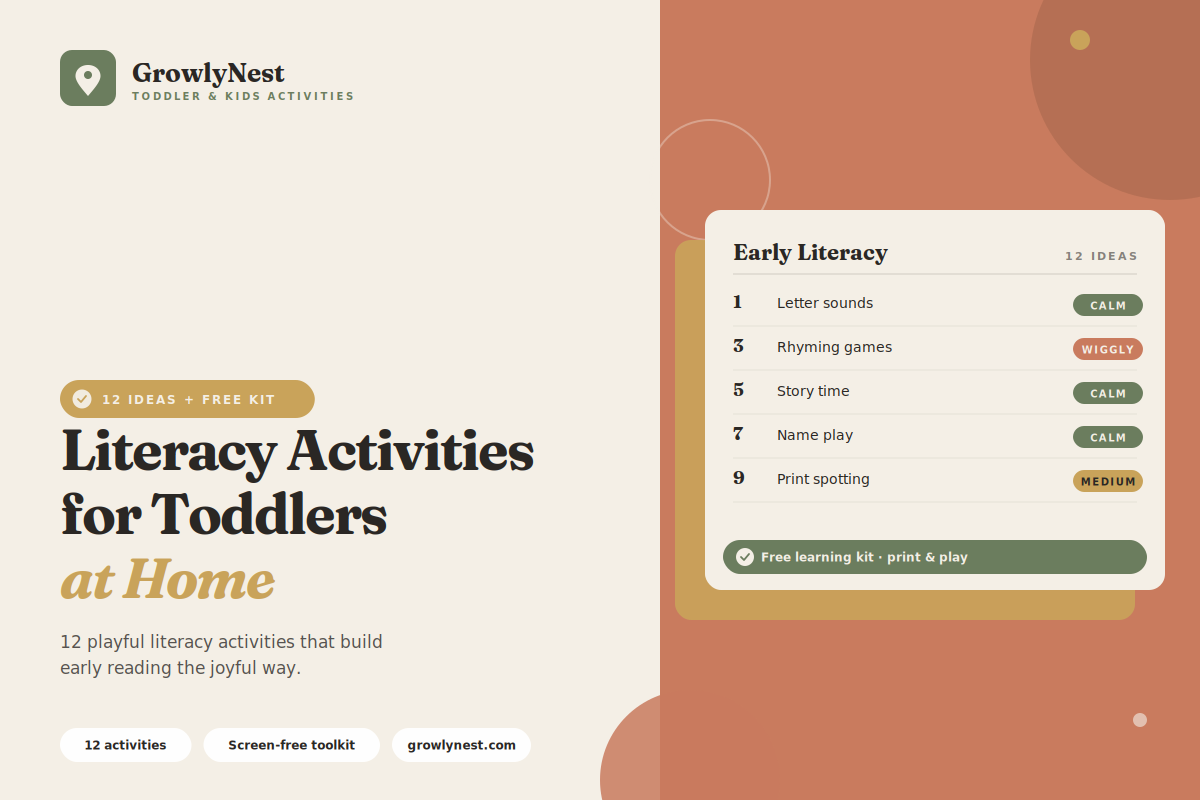
Early Literacy · Ages 1–4 · Pre-Reading
Early literacy can feel like high-stakes territory — but building a reader is far gentler and more joyful than worksheets suggest. Literacy activities for toddlers are mostly about play, sounds, stories, and conversation, not formal lessons. Here are 12 playful literacy activities that build the foundations of reading, with reassurance built in for every worried parent.
How early literacy really develops
Reading isn't a single skill switched on by drilling letters — it's built on a wide foundation laid down through the toddler years. That foundation includes a love of books, a rich vocabulary, the ability to hear and play with the sounds in words, understanding that print carries meaning, and strong listening and storytelling skills. All of this develops through everyday play, talk, and shared reading — not through worksheets or pressure.
If you're anxious about whether your toddler is "behind" on letters, please be reassured: at this age, exposure and enjoyment matter far more than mastery, and children become ready for formal reading at very different times — all perfectly normal. The most powerful thing you can do is read together and talk together, every day. The activities below are simply playful ways to build literacy foundations. Pick what your child enjoys, and let it feel like fun, because joyful early experiences are what create willing readers.
Free home learning download
Get the Free Home Learning Starter Kit
Includes the reassuring guide every parent needs — what toddlers actually need to learn before school, and what can wait — plus letters, numbers, shapes and fine-motor worksheets, hands-on activity cards, a “learning through the day” guide for everyday moments, and a simple skills-by-age reference.
Download the Free Learning Kit →Activities that build sound awareness and phonics
Hearing and playing with sounds is a crucial pre-reading skill — and it's wonderfully playful.
01. Rhyming games and songs
Sing rhyming songs, read rhyming books, and play silly rhyming games. Hearing rhyme tunes a child's ear to the sounds in words — a key foundation for reading, built entirely through fun.
02. Letter sound play
Focus on the sounds letters make, not just their names — "sss" for snake. Play I-spy with sounds and notice them in everyday words. Sound awareness is what later unlocks reading.
03. Clap out syllables
Clap the beats in names and words — "ba-na-na." Breaking words into chunks builds the sound awareness that underpins reading and spelling, and toddlers find it genuinely fun.
04. Sound matching games
Gather objects and group those starting with the same sound, or play "which one starts with mmm?" Noticing initial sounds is an important, playful pre-reading skill.
Activities that build a love of books and stories
A child who loves books becomes a reader. These activities make stories central and joyful.
05. Read together every single day
Daily shared reading is the most powerful literacy activity there is — it builds vocabulary, comprehension, print awareness, and a lifelong love of books. Make it cosy, regular, and entirely pressure-free.
06. Talk about the story
As you read, pause to wonder aloud — what might happen next, how a character feels, what your child notices. This builds comprehension and shows that stories are for thinking about, not just hearing.
07. Retell and act out stories
Encourage your toddler to retell a favourite story in their own words, or act it out with toys. Retelling builds sequencing, memory, and narrative skills — the backbone of reading and writing.
08. Make up stories together
Invent silly stories together, taking turns to add a bit. Storytelling builds language, imagination, and an understanding of how stories work — and it's a delight to do.
Quietly wondering “am I doing enough?”
You almost certainly are — and the free Home Learning Starter Kit is here to reassure you. It includes a calm, anti-pressure guide to what toddlers really need before school and what can wait, letters, numbers, shapes and fine-motor worksheets, hands-on activity cards, a “learning through the day” guide, and a simple skills-by-age reference.
Get the Free Learning KitActivities that build print awareness and letters
Gentle, everyday exposure to letters and print is all a toddler needs.
09. Notice print in the real world
Point out print everywhere — signs, labels, packaging, your shopping list. Noticing that print is all around and that it means something is an important early literacy understanding.
10. Play with their name
A child's name is their most motivating word. Build it with magnetic letters, spot its first letter out and about, trace it in sand — a joyful, personal route into letters.
11. Sensory letter exploration
Form letters in salt, sand, or playdough, or trace them with a finger. The hands-on, multi-sensory experience makes letter shapes stick — with no worksheet and no pressure.
12. Sing the alphabet and play letter games
Sing the alphabet, read alphabet books, and play gentle letter games. Casual, repeated, playful exposure familiarises a child with letters far better than drilling.
Tips for joyful early literacy
1. Read aloud every day, no matter what
If you do just one literacy activity, make it daily shared reading. Nothing else builds vocabulary, comprehension, and a love of books as powerfully — and it costs nothing but time.
2. Focus on sounds and stories before letters
Sound awareness and a love of stories are the real foundations of reading. Letter knowledge follows naturally — there's no need to drill letters early.
3. Keep it playful, never a chore
Literacy activities should feel like games and cuddles, not lessons. A child who finds early literacy joyful becomes a willing reader; pressure does the opposite.
4. Let go of comparison and timelines
Children become ready to read at very different ages, all normal. Comparing your toddler to others or to a timeline causes needless worry — trust your child's own path.
Frequently asked questions
When should a toddler learn to read?
Toddlers aren't expected to read — the toddler years are for building the foundations of reading through stories, sounds, talk, and play. Children become ready for formal reading at very different ages, generally during the school years, and all of that variation is normal.
What is the best literacy activity for toddlers?
Daily shared reading. Reading aloud together builds vocabulary, comprehension, print awareness, and a love of books better than any other single activity — and it strengthens your bond at the same time.
My toddler doesn't know any letters yet. Should I worry?
No. Letter knowledge develops gradually and at very different ages. At this stage, sound awareness, a love of stories, and rich language matter far more than knowing letters. Keep it playful and the letters will come.
Do I need phonics worksheets for my toddler?
No. Phonics foundations — hearing rhyme, noticing sounds, playing with words — are built far better through songs, games, and conversation than through worksheets. Toddlers learn sounds through play.
How can I tell if my toddler is on track for reading?
Look for the foundations rather than reading itself — enjoying books, joining in with rhymes, noticing sounds, talking and telling stories, understanding that print means something. These signs matter far more than letter knowledge at this age.
The Home Learning Starter Kit
Home learning, without the pressure
Everything in one free, reassuring download: the guide to what toddlers actually need before school and what can wait, letters, numbers, shapes and fine-motor worksheets, hands-on activity cards, a “learning through the day” guide for everyday moments, and a simple skills-by-age reference.
Download the Free Learning Kit →Free forever · No spam · Unsubscribe any time
From the GrowlyNest family — helping you nurture curious, confident learners through play, without the pressure.
You're getting — completely free
The Home Learning Pack
Here's how to get it
It arrives in 1–2 minutes — check your inbox now.
If you don't see the "Gift File" check your Promotions or Spam folder. Drag it to your main inbox so future emails reach you.
Loading Viewer...