Pre-Reading & Math · Ages 3–5 · Hands-On
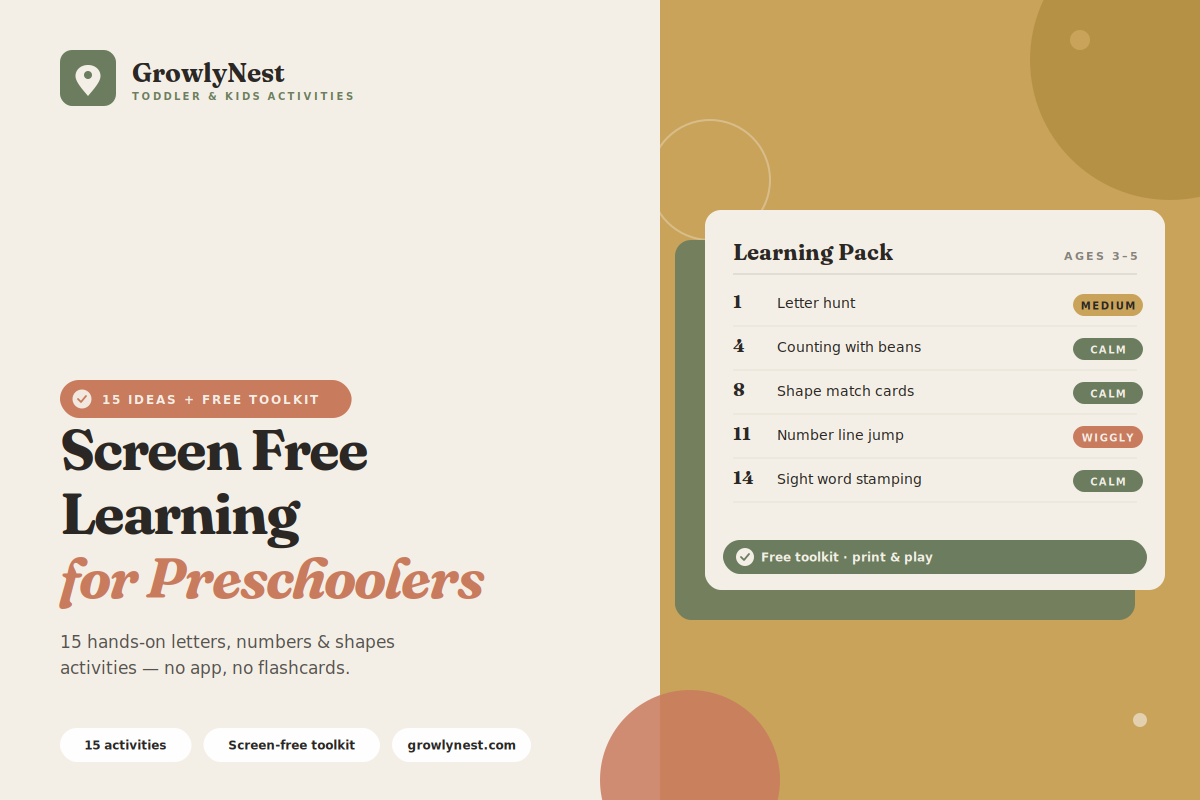
Preschoolers learn letters, numbers, and shapes fastest when they can touch them — not tap them. These 15 screen free learning activities for preschoolers turn early concepts into hands-on play, and they beat any "educational" app for genuine engagement and retention. Here's a full set of educational activities with no screen required.
Why hands-on learning beats screen-based "edutainment"
Research consistently shows that preschoolers learn early literacy and math better through hands-on play than through screen-based apps. Touching, moving, and pretending build the brain pathways that flashcards and tablets simply can't.
Hands-on learning also keeps the joy in it. A preschooler hunting for letters around the house or jumping along a number line is learning and having fun at once — and a child who enjoys learning keeps wanting more of it.
Free printable download
Get the Free Screen-Free Toddler Toolkit
A parent guide on replacing screen time, 30 activity cards across 6 categories, a Quick Finder page, a weekly screen-free planner, and a bonus jar label — all free.
Download the Free Toolkit →Letters and early reading
01. Letter hunt
Call out a letter and have your child find objects around the house that start with it. Playful phonics with no worksheets.
02. Sensory letter writing
Write letters with a finger in a tray of sand, salt, or shaving foam. The tactile feedback helps letters stick.
03. Letter stamping
Use letter stamps and an ink pad to make words and names. Hands-on and endlessly repeatable.
04. Alphabet sensory bag
Hide foam letters in a bag of rice and have your child find and name them by feel and sight.
05. Read-aloud and retell
Read a favorite book, then have your child retell it in their own words. The single best predictor of reading readiness.
Numbers and early math
06. Counting collections
Count beans, buttons, or toy cars into groups. Hands-on counting builds genuine number sense.
07. Number line jumping
Tape numbers on the floor and have your child jump to the answer of a simple question. Math plus movement.
08. Sorting and grouping
Sort objects by size, color, or type, then count each group. Early math thinking, presented as play.
09. Pattern building
Make repeating patterns with blocks or beads — red, blue, red, blue — a foundational math skill.
10. Measuring play
Measure and compare objects with a ruler, string, or blocks. "Longer" and "shorter" come alive through doing.
Want all of this on printable cards?
The free Screen-Free Toddler Toolkit turns these ideas into 30 ready-to-use activity cards, sorted into 6 categories, with a Quick Finder page so you can grab the right one in seconds.
Get the Free ToolkitShapes, colors, and thinking skills
11. Shape hunt
Spot circles, squares, and triangles around the house and yard. Shapes are everywhere once you start looking.
12. Color mixing
Mix paint or colored water with droppers to discover new colors. A bit of science, a bit of magic.
13. Matching games
Match pairs — socks, cards, objects to shadows. Memory and visual discrimination in a simple game.
14. Simple puzzles
Jigsaw puzzles build problem-solving, spatial reasoning, and the patience to work toward a goal.
15. Sorting by attribute
Sort a mixed bin by more than one rule at once — big red things, small blue things. Early logical thinking.
How to make learning play effective
1. Teach letter recognition before sounds
Help your preschooler recognize letters first; phonics and sounds come more naturally a bit later, usually around age four.
2. Keep it playful, not drill-like
Ten minutes of hands-on, game-based learning beats thirty minutes of flashcards. Stop while it's still fun.
3. Read aloud every single day
Daily reading is the strongest predictor of later reading success. Make it a non-negotiable, cozy routine.
4. Follow your child's interests
A child fascinated by dinosaurs will count, sort, and letter-hunt far longer with dinosaurs than with anything you pick.
Frequently asked questions
Aren't learning apps better for teaching letters and numbers?
Hands-on learning is consistently more effective for preschoolers, and this is well studied. Touching and moving builds understanding that tapping a screen doesn't.
My preschooler wants to learn — should I push academics hard?
Follow their curiosity rather than a formal curriculum. Playful, hands-on learning builds more at this age than drilling ever will.
How much learning play does a preschooler need daily?
Around 30–60 minutes total, in short, engaged bursts, is plenty. Quality and enjoyment matter far more than quantity.
My child isn't interested in letters or numbers yet. Should I worry?
Children develop on their own timelines. Keep learning playful and interest-led, read aloud daily, and the readiness usually follows.
Do these activities need special materials?
Most use everyday items — beans, blocks, tape, paper, kitchen objects. A few foam letters or stamps help but aren't essential.
The Screen-Free Toddler Toolkit
Make screen-free days the easy default
Everything in one free download: a parent guide on replacing screen time, 30 activity cards in 6 categories, a Quick Finder page, a weekly screen-free planner, and a bonus activity-jar label.
Download the Free Toolkit →Free forever · No spam · Unsubscribe any time
From the GrowlyNest family — helping you raise calm, curious, screen-free kids.
You're getting — completely free
The Screen-Free Toddler Toolkit Bundle
Here's how to get it
It arrives in 1–2 minutes — check your inbox now.
If you don't see the "Gift File" check your Promotions or Spam folder. Drag it to your main inbox so future emails reach you.
Loading Viewer...