
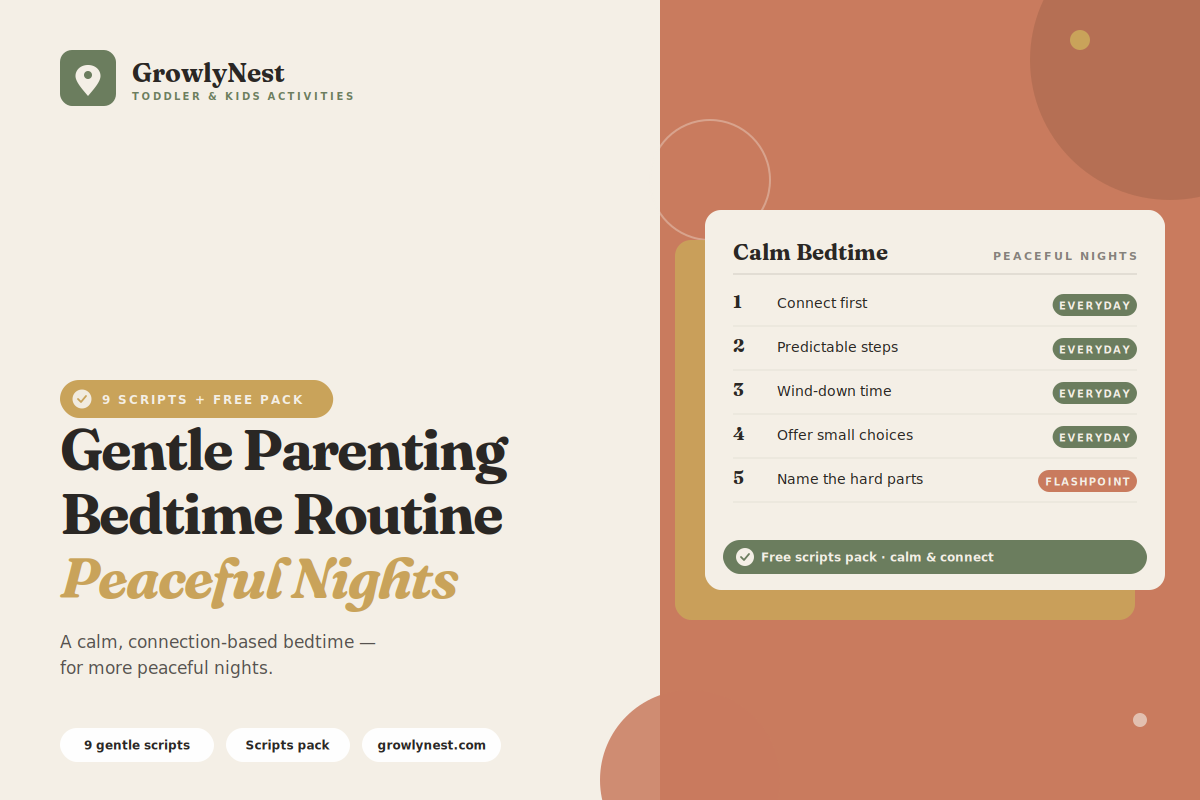
Gentle Parenting · Bedtime · Routines
Bedtime can be the sweetest part of the day — or the hardest. If yours currently involves stalling, tears, repeated requests for water, and a toddler who pops up like toast every time you tiptoe out, you're not alone, and you haven't done anything wrong. Here's a gentle parenting bedtime routine built around connection and calm, for genuinely more peaceful nights.
Why bedtime is so hard for toddlers
Bedtime asks a toddler to do several genuinely difficult things at once, all at the hardest possible time of day. They have to stop playing, separate from you, let go of an interesting day, and surrender to sleep — and they have to do it when they are tired, which is exactly when their coping resources are lowest. Bedtime is also dense with transitions, which toddlers find hard, and it taps into a deep need for closeness: many toddlers resist bedtime not to be difficult but because being apart from you is genuinely hard for them. Seen this way, bedtime resistance is a developmental reality, not misbehaviour.
Gentle parenting's insight is that the most effective bedtime is built on connection and predictability, not pressure. A toddler who feels deeply connected and is moving through a calm, known routine settles far more easily than one being hurried and nagged toward sleep. This is not permissive — the routine still happens, lights still go out, and bedtime still arrives. Gentle parenting simply gets there through warmth, structure, and small doses of autonomy rather than through escalating frustration. Meet the need for connection generously at bedtime, and a surprising amount of the resistance — which was often a bid for closeness all along — quietly falls away.
Free printable download
Get the Free Gentle Parenting Scripts Pack
A guide on what gentle parenting actually is — and isn't — that clears up the permissive confusion, plus printable scripts for the real daily flashpoints (tantrums, hitting, biting, not listening, sharing, transitions, public meltdowns, the word “no”), a one-page fridge quick-reference, repair scripts for after you lose it, and a parent calm-down toolkit.
Download the Free Scripts Pack →Building a calm bedtime routine
These steps create a bedtime routine that works with a toddler's needs rather than against them.
01. Start with a wind-down buffer
Sleep doesn't switch on instantly, so build a buffer of calm before the routine even begins — dim the lights, lower the noise and pace, switch off screens well ahead of time. This wind-down signals to a toddler's body and brain that the day is closing, making the rest of the routine far smoother.
02. Lead with connection
Open the bedtime routine with genuine, unhurried connection — a cuddle, a chat about the day, a few minutes of undivided attention. A toddler whose connection cup is full at bedtime feels secure enough to separate and sleep. Connection first isn't a delay tactic; it's the foundation of an easy bedtime.
03. Keep the steps the same every night
Toddlers find deep security in knowing exactly what comes next, so keep the routine steps in the same order each night — bath, pyjamas, teeth, two stories, song, lights out. A predictable sequence lets a toddler anticipate and cooperate, and lets the routine itself carry things along instead of your reminders.
04. Offer small choices within the routine
Meet a toddler's need for control with choices that don't derail bedtime: "Which two stories tonight?" "Red pyjamas or the blue ones?" "Teeth first or pyjamas first?" The routine and bedtime itself stay non-negotiable; the small choices give genuine autonomy, which heads off many bedtime standoffs.
05. Use a visual bedtime chart
A simple picture chart of the bedtime steps turns an abstract routine into something a toddler can see and follow. It shifts authority from you ("because I said so") to the chart ("what's next on our chart?"), removing you from the power struggle and giving your toddler a satisfying sense of independent mastery.
Never stuck for what to say again
The free Gentle Parenting Scripts Pack gives you calm, kind words ready for every hard moment — printable scripts for tantrums, hitting, not listening, sharing, transitions and more, a one-page fridge quick-reference, repair scripts for after you lose it, and a parent calm-down toolkit.
Get the Free Scripts PackHandling bedtime resistance gently
Even with a lovely routine, bedtime brings wobbles. Here's the gentle, firm way through.
06. Name the hard parts
Acknowledge what's genuinely difficult about bedtime: "It's hard to stop playing." "You wish the day didn't have to end — it's hard to say goodnight." Naming the feeling helps your toddler feel understood, which makes the bedtime steps easier to accept than if the feeling is brushed aside.
07. Hold the limit with warmth
When your toddler resists or stalls, stay calm and keep the routine moving — kindly. "I know you want to keep playing. It's still bedtime, and I'm right here with you." Holding the limit teaches that bedtime is reliable; keeping the warmth teaches that the feeling is allowed. Both at once.
08. Handle the stalling calmly and consistently
The water requests, the "one more story," the sudden urgent news — handle these with calm, predictable consistency. Decide your reasonable limits in advance (one drink, two stories) and hold them the same way every night. Calm consistency teaches the routine far better than negotiating fresh terms each evening.
09. Meet the need for closeness
Much bedtime resistance is a genuine bid for connection, so meet it generously rather than treating it as manipulation. Extra cuddles, staying a few minutes, a comforting goodnight ritual — meeting the need for closeness often resolves more bedtime struggle than any amount of firmness aimed at the wrong cause.
Tips for peaceful bedtimes
1. Protect the wind-down time
Rushing into bedtime from a stimulating evening sets everyone up to struggle. Guard a calm buffer before the routine — it's one of the highest-value parts of a peaceful bedtime.
2. Be boringly consistent
A bedtime routine works because it's predictable. Keep the steps, the timing, and your limits steady night after night — consistency is what makes bedtime feel safe and known.
3. Lead with connection, not instructions
Open bedtime with genuine closeness before any tasks. A connected toddler settles; a toddler met with a list of commands resists. Connection first changes the whole tone.
4. Keep your own bedtime expectations realistic
Toddler sleep is genuinely variable, and some nights will be hard however well you do everything. Aim for a calmer routine overall, not a perfect one, and be kind to yourself on the rough nights.
Frequently asked questions
Why does my toddler resist bedtime so much?
Bedtime asks a toddler to stop playing, separate from you, let go of the day, and fall asleep — all when they're tired and low on coping resources. Resistance is often a genuine bid for connection too. It's a developmental reality, not misbehaviour or a sign you've done something wrong.
How do I make a gentle parenting bedtime routine?
Build a calm wind-down buffer, lead with connection, keep the steps the same every night, offer small choices within the routine, and consider a visual bedtime chart. When resistance comes, name the hard feeling and hold the limit with warmth. Connection and predictability are the foundations.
Isn't offering choices at bedtime just giving in?
No — bedtime itself and the routine stay completely non-negotiable. The choices are small ones within that fixed frame: which stories, which pyjamas. This meets a toddler's need for control without giving up bedtime, so it's structure with autonomy, not permissiveness.
How do I handle bedtime stalling — the water, 'one more story'?
Decide reasonable limits in advance (one drink, two stories) and hold them calmly and consistently every night. Predictable limits teach the routine far better than negotiating new terms each evening. Also check whether the stalling is a genuine bid for connection that could be met earlier.
My toddler keeps getting out of bed. What can I do?
Keep the routine calm and consistent, meet the need for connection generously within it, and respond to getting up in a calm, low-key, predictable way each time — gently returning them with minimal fuss. Consistency and connection, applied patiently, tend to settle this over time.
The Gentle Parenting Scripts Pack
Calm, kind words for every hard moment
Everything in one free download: a guide on what gentle parenting actually is and isn't, printable scripts for the real daily flashpoints — tantrums, hitting, biting, not listening, sharing, transitions, public meltdowns, the word “no” — a one-page fridge quick-reference, repair scripts for after you lose it, and a parent calm-down toolkit.
Download the Free Scripts Pack →Free forever · No spam · Unsubscribe any time
From the GrowlyNest family — cheering you on as you parent with empathy and firm, loving boundaries. You're doing a hard job, and doing it with care.
You're getting — completely free
The Gentle Parenting Scripts Pack
Here's how to get it
It arrives in 1–2 minutes — check your inbox now.
If you don't see the "Gift File" check your Promotions or Spam folder. Drag it to your main inbox so future emails reach you.
Loading Viewer...