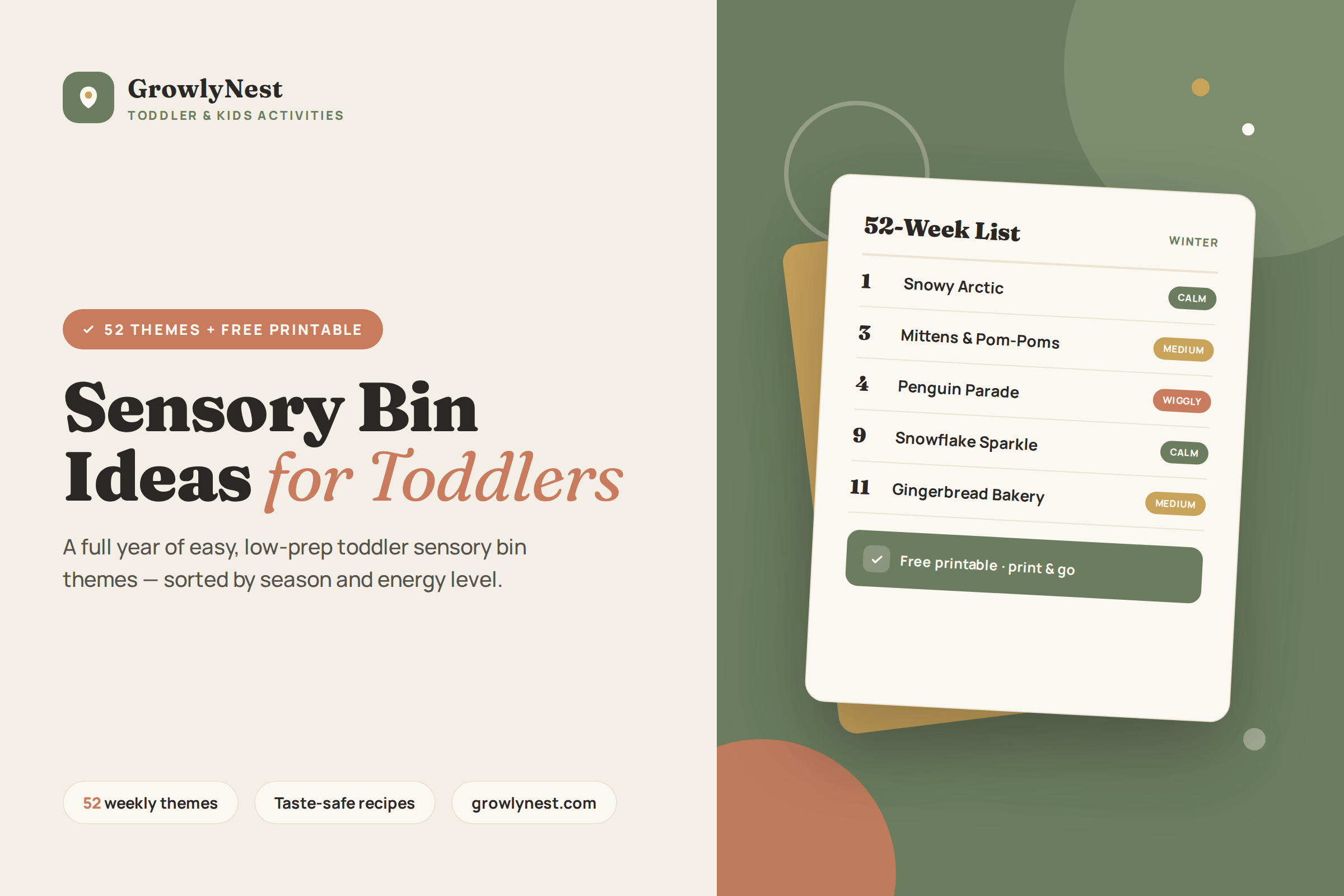
A full year of easy, low-prep sensory bins — sorted by season and energy level, built around the stuff already in your kitchen. Plus a free printable toddler sensory bin themes list at the end.
52 Sensory Bin Themes
A whole year of sensory bins
— already planned
WINTER · SPRING · SUMMER · FALL
If you’ve ever stood in your kitchen at 8am wondering how to keep a busy toddler happily occupied for twenty minutes, you already understand why sensory bins are a parenting staple. The problem is rarely the bin itself — it’s coming up with a fresh idea every single time.
So this guide does that part for you. Below you’ll find 52 sensory bin ideas for toddlers — one for every week of the year — organized by season and tagged by energy level so you can match the activity to your child’s mood. Whether you’ve never set up a bin before or you’re deep into your sensory play era and just need new toddler sensory bin themes, there’s something here for this week.
And if you’d rather not scroll back every time, there’s a free printable version of all 52 themes waiting at the bottom of this post.
What is a sensory bin — and why do toddlers love them?
A sensory bin is simply a container filled with a base material — rice, oats, water, sand — plus a few tools and themed objects for your child to explore. That’s the whole concept. No instructions, no “right” way to play.
The reason sensory bins work so well for toddlers is that they hit several kinds of development at once. Scooping and pouring builds fine-motor control. Naming what they find grows vocabulary. And the open-ended nature of it stretches attention span in a way few toy activities can. To a toddler it just feels like play — which is exactly the point.
The hardest part of sensory play isn’t the setup. It’s deciding what to do this week.
Want all 52 themes on one printable?
Grab the free 52-Week Sensory Bin Theme List — a clean, print-and-go PDF with every theme, energy level, and fill-it-with idea in this post. Stick it on the fridge and never plan a bin from scratch again.
How to set up a toddler sensory bin in 4 steps
Before we get to the themes, here’s the simple framework every bin follows. Once it clicks, you can set one up in about two minutes.
Choose a shallow container
A plastic bin, under-bed box, or even a baking tray works. Lay a towel or splash mat underneath — it catches the majority of the mess and makes cleanup a 30-second job.
Add a base material
Fill the bin about one-third full. Dry rice, rolled oats, dried beans, split peas, play sand, shredded paper, or water with a drop of soap are all excellent. Use what you have.
Pick a theme and add a few extras
This is where the 52 toddler sensory bin themes below come in. Add a handful of figures, scoops, cups, and tools that match — you rarely need more than four or five items.
Supervise, set one boundary, and let go
Stay within arm’s reach. Set a single rule — usually “the bin stays on the mat” — and then let your toddler explore however they like. Ten to twenty minutes is the sweet spot.
Match the bin to the mood: the energy-level system
Not every sensory bin fits every moment. A wild, water-and-scooping bin is a poor choice ten minutes before nap. So every theme in this guide — and in the printable — is tagged with one of three energy levels:
Calm
Quiet, focused play. Great for wind-down time, early mornings, or alongside a sibling’s nap.
Medium
Hands busy, lots of scooping and pouring. The everyday sweet spot for most toddlers.
Wiggly
Big movement and big mess. Best saved for outside or a wipe-clean mat when energy is high.
Once you start thinking this way, choosing a bin becomes effortless — you’re matching it to the day rather than hoping for the best.
52 sensory bin ideas for toddlers, sorted by season
Here’s a season-by-season look at the year. We’ve pulled a handful of favorites from each season below — the complete set of all 52 toddler sensory bin themes is in the free printable.
Winter Sensory Bins
Frosty, cozy, and mostly calm — winter bins are made for short days and indoor afternoons.
Calm
Calm
Wiggly
Medium
Spring Sensory Bins
Mud, rain, and new growth — spring bins get a little messier and a lot more curious.
Wiggly
Calm
Medium
Medium
Summer Sensory Bins
Water, sand, and sunshine — summer bins are made for the backyard, so take them outside.
Wiggly
Calm
Wiggly
Medium
Fall Sensory Bins
Pumpkins, leaves, and harvest — fall bins are warm, tactile, and full of seasonal favorites.
Medium
Medium
Calm
Calm
That’s 16 of the 52 — a season’s worth of ideas to get you started. The remaining 36 sensory bin ideas for toddlers, including every energy tag and fill-it-with suggestion, are all in the free printable below.
Taste-safe base recipes for toddlers who still mouth everything
If your toddler still explores with their mouth, you don’t have to skip sensory play — you just choose edible bases and skip small loose parts. A few favorites:
- Rainbow oat sandToss dry rolled oats with a few drops of food coloring in a zip bag, then spread to dry. Soft, scoopable, totally taste-safe.
- Cloud spaghettiCook spaghetti, cool it fully, and toss with a teaspoon of oil so it won’t stick. Stretchy and endlessly fun.
- Cocoa play dirtMix flour with a spoon of cocoa powder for a soft “soil” that smells amazing — perfect for digging themes.
- Edible snowStir cornstarch with a little shredded coconut until it’s powdery and cool to the touch. It even packs like real snow.
The printable includes one more taste-safe recipe plus the full method for each, so you’ve always got a safe base on hand.
5 quick tips that make sensory play actually work
A few small habits separate sensory play that fizzles after five minutes from sensory play that genuinely buys you twenty:
- Keep sessions shortEnd while your toddler is still enjoying it — they’ll be eager to come back next time instead of burned out.
- Rotate, don’t retireStore dry bins in labeled zip bags and bring them back in a few weeks. An old bin feels brand new after a break.
- Narrate, don’t directDescribe what you see — “you’re pouring so slowly” — instead of giving instructions. It builds language and keeps play open-ended.
- Make peace with messSet the boundary, then let the rest go. A contained mess is simply the price of twenty calm minutes.
- Follow their leadIf your child turns the pumpkin patch into a tea party, let them. Curiosity matters far more than the theme.
Key takeaways
- Sensory bins build fine-motor skills, language, and focus — and they only need a container, a base, and a theme.
- Match each bin to your toddler’s mood using the Calm, Medium, and Wiggly energy levels.
- These 52 toddler sensory bin themes are sorted by season so they line up with the world outside.
- For mouthing toddlers, taste-safe bases like oat sand and cloud spaghetti keep sensory play accessible.
- Short sessions, bin rotation, and following your child’s lead are what make sensory play last.
Get the 52-Week Sensory Bin Theme List
Every theme in this post — plus the 36 we didn’t have room for — on one clean, print-and-go PDF. Tap the button and it’s yours in seconds.
- All 52 weekly themes, sorted by season
- Energy level + fill-it-with idea for every bin
- 5 taste-safe base recipes from your kitchen
- Free for personal and classroom use
No spam, ever — just GrowlyNest activity ideas. Unsubscribe anytime.
Sensory bin FAQs
Q. What age can toddlers start playing with sensory bins?
Most toddlers are ready around 12 to 18 months with close supervision. For children who still put things in their mouths, stick to taste-safe bases like dry oats or cooked pasta and skip small loose parts.
Q. What can I use as a sensory bin base?
Dry rice, rolled oats, dried beans, split peas, play sand, shredded paper, pom-poms, and soapy water all make great sensory bin bases. Most are inexpensive and already somewhere in your kitchen.
Q. How do I store sensory bins between uses?
Dry materials keep for months in a sealed container or a labeled zip bag. Rotate two or three bins so each one feels fresh when it comes back out.
Q. How long should a toddler play with a sensory bin?
Ten to twenty minutes is plenty for most toddlers. End the activity while your child is still enjoying it so they stay eager to come back to it.
Your next twenty calm minutes start here
You don’t need a Pinterest-perfect setup or a single new purchase to begin — a baking tray, a cup of dry rice, and one theme from this list is a complete first sensory bin. Start there, and let curiosity do the rest.
And when you want the whole year mapped out in one place, the free 52-Week Sensory Bin Theme List is ready whenever you are. Print it once, stick it on the fridge, and never plan a bin from scratch again.
One printable. A whole year of sensory bins.
Join thousands of parents who plan less and play more. The 52-Week Sensory Bin Theme List is free — grab your copy now.
You're getting — completely free
52-Week Printable Sensory Bin Theme List
Here's how to get it
It arrives in 1–2 minutes — check your inbox now.
If you don't see the "Gift File" check your Promotions or Spam folder. Drag it to your main inbox so future emails reach you.
Loading Viewer...