
Emotional Regulation · Ages 2–5 · Big Feelings
When a toddler is swept up in a big emotion, they genuinely cannot think their way calm — their developing brain simply isn't built for that yet. A calming routine chart gives them something they can use: a clear, visual sequence of steps to move through a big feeling. Here's a complete calm-down routine, plus how to help your toddler actually use it.
Why a calming routine chart helps with big emotions
Toddlers feel enormous emotions in a brain that hasn't yet developed the wiring to manage them. In the grip of a big feeling, they can't access reason or remember what to do — which is why "calm down" never works. A calming routine chart gives a toddler an external, visual guide: a simple, predictable set of steps they can be walked through, again and again, until the sequence becomes familiar enough to lean on. The chart does the remembering when the toddler can't.
Used consistently, a calming chart teaches genuine emotional regulation — one of the most valuable life skills there is. Over time, a toddler repeatedly guided through the same calm-down steps begins to internalise them, and slowly learns to recognise feelings and move through them. It works best introduced and practised during calm moments, not invented mid-meltdown, which the strategies below explain.
Free routine chart download
Get the Free Complete Kids Routine Chart Bundle
Includes the guide parents really need — how to get kids to actually follow the chart — plus morning, bedtime, after-school and chore charts, a routine builder worksheet to design your routine first, blank customisable versions, pre-reader picture cards, and travel and weekend troubleshooting.
Download the Free Routine Bundle →A sample calming routine for toddlers
Here is a gentle, copyable calm-down sequence. Practise it together when your toddler is calm, so the steps are familiar when big feelings hit.
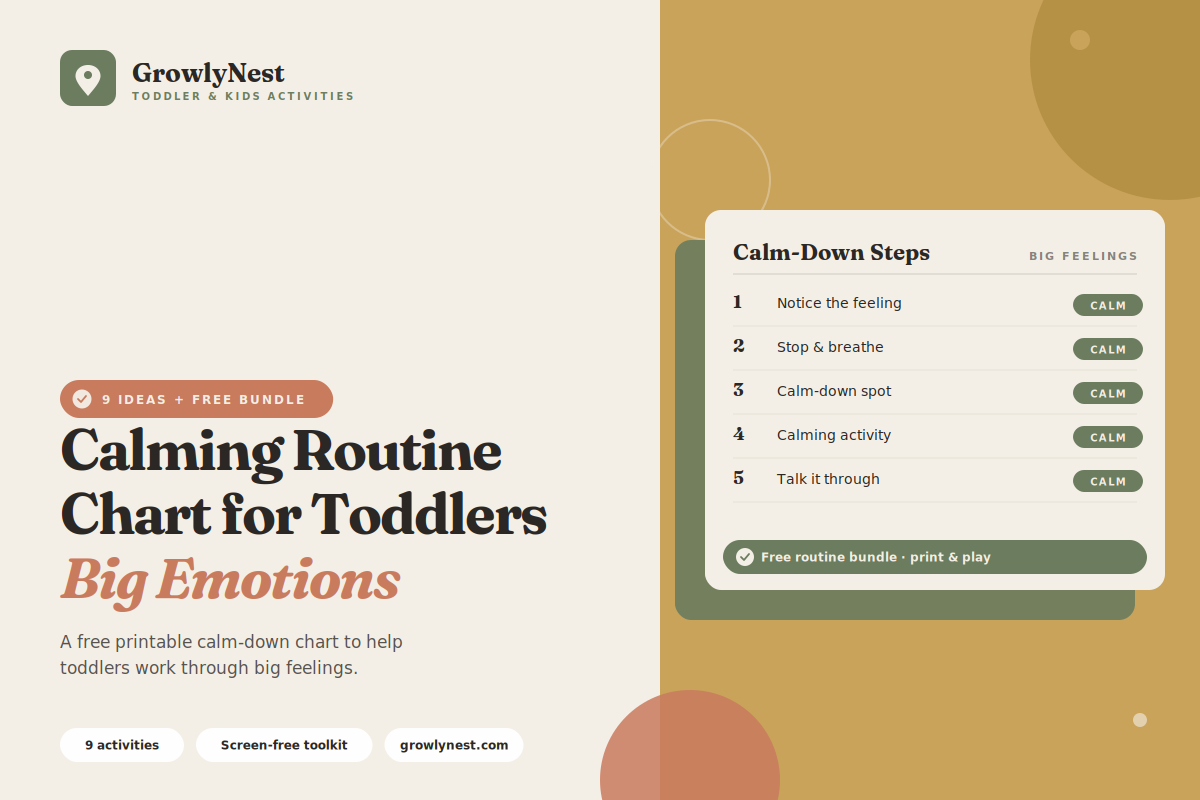
01. Notice and name the feeling
Help your toddler notice and name what they feel — "you're feeling really frustrated." Naming a feeling is the first step to managing it, and being understood is itself calming.
02. Stop and take deep breaths
Guide a few slow, deep breaths together — "smell the flower, blow out the candle." Deep breathing genuinely calms the body's stress response, and doing it together makes it easier.
03. Go to the calm-down spot
Move to a designated cosy, quiet calm-down space. Having a consistent, safe place to go gives a toddler a clear, comforting next step.
04. Use a calming activity
In the calm-down spot, offer a soothing activity — squeezing playdough, a sensory bottle, a soft toy, looking at a book. A calming sensory activity gives the big feeling a gentle physical outlet.
05. Talk it through and reconnect
Once your toddler is calmer, talk gently about what happened and reconnect with a cuddle. This is where a little learning happens — but only after calm returns, never during the storm.
Struggling to get your child to follow the chart?
A chart on the wall is the easy part — getting kids to actually follow it is the real struggle. The free Complete Kids Routine Chart Bundle includes the step-by-step guide for exactly that, plus a routine builder worksheet, ready-made charts, pre-reader picture cards, and troubleshooting for travel and weekends.
Get the Free Routine BundleHow to help your toddler use the calming chart
A calming chart works only if your toddler can genuinely lean on it. These strategies make that possible.
06. Introduce and practise it when calm
Teach the calm-down steps during peaceful moments, not mid-meltdown. Your toddler needs to know the routine well before they can possibly use it while upset.
07. Stay calm and guide gently
When a big feeling hits, your own steadiness is part of the calming. Gently walk your toddler through the chart's steps rather than expecting them to do it alone.
08. Acknowledge the feeling first
Always start by naming and accepting the feeling — never dismiss it or rush to fix it. A toddler who feels understood can move through the steps; one who feels dismissed cannot.
09. Be patient and consistent
Learning to regulate takes years, not weeks. Use the chart consistently, expect slow progress, and know that every guided calm-down is building a real, lasting skill.
Tips for supporting emotional regulation
1. Model calm yourself
Toddlers learn regulation by watching you. Naming your own feelings and showing how you calm down teaches more than any chart can on its own.
2. Set up a calm-down corner
Create a cosy, inviting calm-down space with soft things and a few sensory tools. A consistent, safe spot makes the chart's steps far easier to follow.
3. Never use the calm-down spot as punishment
The calm-down space must be a comforting refuge, not a time-out or punishment. If it feels like a consequence, your toddler won't want to use it.
4. Celebrate the small wins
Notice when your toddler uses any part of the routine — "you took deep breaths, that was so helpful." Warm encouragement builds the habit and the skill.
Frequently asked questions
What age can a toddler use a calming routine chart?
A simple, picture-based calming chart can help toddlers from around age 2, with a parent guiding them through the steps. The skill of regulation develops gradually over the following years.
Can a chart really calm a toddler in a meltdown?
A chart gives a toddler — and you — a clear, familiar sequence to move through, which genuinely helps. But it works only if practised during calm times first, and if you gently guide your toddler through it rather than expecting them to manage alone.
My toddler is too upset to use the chart. What then?
At the peak of a meltdown, a toddler often can't engage with any steps — and that's normal. Stay calm and close, acknowledge the feeling, keep everyone safe, and guide the chart's steps as your toddler begins to come down.
Isn't a calm-down spot just a time-out?
No — and the difference matters. A calm-down spot is a comforting, safe refuge a toddler chooses or is gently guided to, never a punishment. If it's used as a consequence, it stops working.
How long until my toddler can regulate emotions independently?
Emotional regulation develops gradually over years, not weeks. A calming chart, used consistently and with patience, steadily builds the skill — but expect slow, uneven progress, which is completely normal.
The Complete Kids Routine Chart Bundle
A routine that actually sticks
Everything in one free download: the guide to getting kids to actually follow the chart, morning, bedtime, after-school and chore charts, a routine builder worksheet to design your routine first, blank customisable versions, pre-reader picture cards, and troubleshooting for travel and weekends.
Download the Free Routine Bundle →Free forever · No spam · Unsubscribe any time
From the GrowlyNest family — helping you build calm, predictable routines your children genuinely follow.
You're getting — completely free
The Complete Kids Routine Chart Bundle
Here's how to get it
It arrives in 1–2 minutes — check your inbox now.
If you don't see the "Gift File" check your Promotions or Spam folder. Drag it to your main inbox so future emails reach you.
Loading Viewer...