
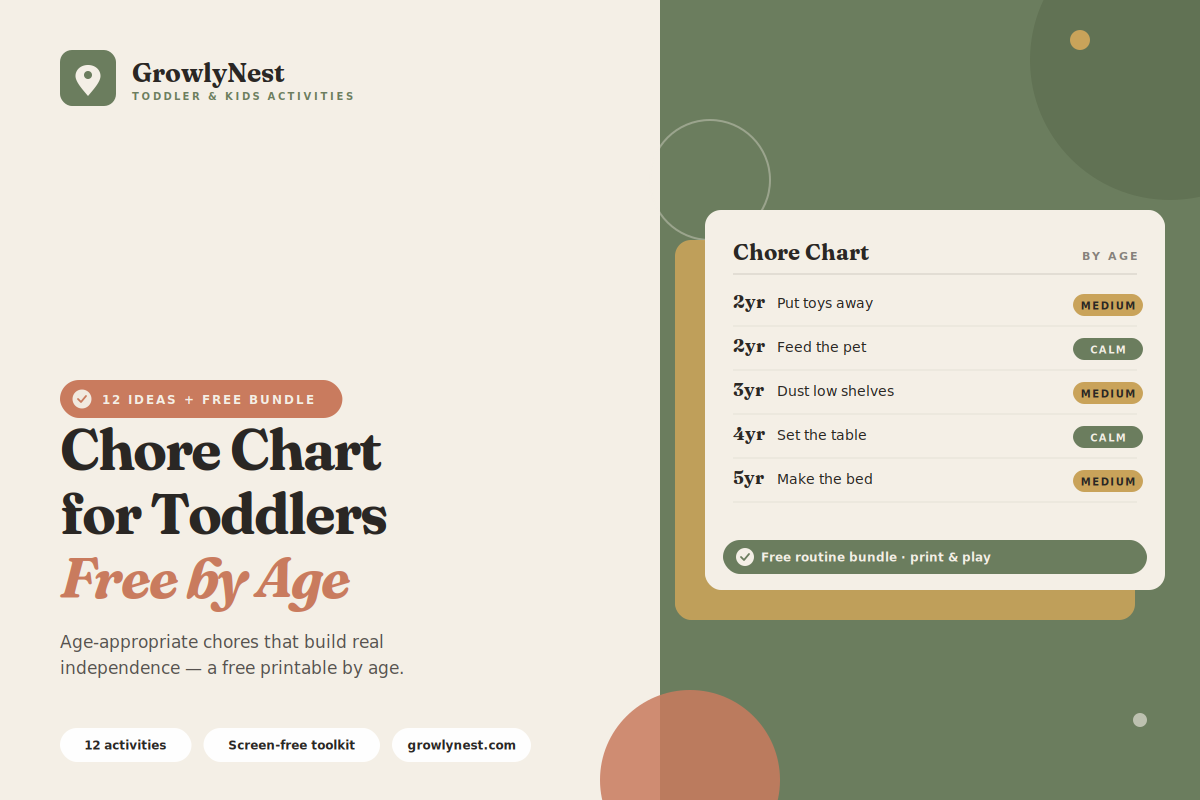
Chores · Ages 2–5 · Independence
It can feel easier to just do everything yourself — but giving toddlers real chores is one of the best gifts you can offer them. Age-appropriate chores build genuine independence, responsibility, and self-worth. A chore chart for toddlers makes those chores visible and consistent. Here's a complete chore list organised by age, plus how to get your child to actually do them.
Why chore charts are worth it for toddlers
Toddlers genuinely want to help — watch any two-year-old try to sweep or wipe a table and you'll see it. Channelling that instinct into real chores builds something important: a sense of capability and of being a contributing member of the family. Children who do chores from young develop responsibility, independence, and self-esteem, and the habit, started early, tends to last. A chore chart makes the expectations clear and visible so chores become a normal part of the day, not a daily debate.
The key is matching chores to the child's age and abilities, and accepting that toddler-done chores will not be perfectly done. A two-year-old's table-wiping leaves streaks; a three-year-old's toy-tidying is approximate. That is completely fine — the goal is the habit, the effort, and the growing competence, not a spotless result. The strategies below help you keep chores positive and actually happening.
Free routine chart download
Get the Free Complete Kids Routine Chart Bundle
Includes the guide parents really need — how to get kids to actually follow the chart — plus morning, bedtime, after-school and chore charts, a routine builder worksheet to design your routine first, blank customisable versions, pre-reader picture cards, and travel and weekend troubleshooting.
Download the Free Routine Bundle →Chores for 2-year-olds
Two-year-olds can manage simple, single-step chores with help. Keep them short, and expect to do them alongside your child.
01. Put toys in a basket
Tidying toys into a basket is a perfect first chore — simple, clear, and easy to do together. It builds the everyday habit of tidying up after play.
02. Put dirty clothes in the basket
Carrying their own clothes to the laundry basket teaches a two-year-old to take responsibility for their things in a small, achievable way.
03. Help feed a pet
With supervision, scooping pet food or filling a water bowl gives a two-year-old a real, caring job they take seriously.
04. Wipe up small spills
A cloth and a small spill to wipe teaches a two-year-old that we clean up after ourselves — and they love the responsibility.
Chores for 3-year-olds
Three-year-olds can handle slightly longer chores and a little more independence.
05. Dust low surfaces
A duster or cloth and some low shelves to dust is a satisfying, achievable chore that builds care for shared spaces.
06. Help set the table
Placing napkins, spoons, or unbreakable cups lets a three-year-old contribute directly to family mealtimes.
07. Water the plants
A small watering can and a few plants teaches gentle responsibility and care for living things.
08. Put away their shoes and coat
Hanging up a coat and putting shoes in their spot builds a tidy, independent habit at the start and end of every outing.
Struggling to get your child to follow the chart?
A chart on the wall is the easy part — getting kids to actually follow it is the real struggle. The free Complete Kids Routine Chart Bundle includes the step-by-step guide for exactly that, plus a routine builder worksheet, ready-made charts, pre-reader picture cards, and troubleshooting for travel and weekends.
Get the Free Routine BundleChores for 4 and 5-year-olds
Four and five-year-olds can take on chores that need a few steps and more independence.
09. Make the bed
Pulling up the covers and arranging pillows — a four or five-year-old can manage a simple version, building a strong daily habit.
10. Set and clear the table
Setting the table and carrying their own plate to the side after meals gives an older preschooler a real, recurring family responsibility.
11. Sort laundry
Sorting laundry into lights and darks, or matching socks, is a genuinely useful chore that also builds sorting and matching skills.
12. Tidy their own room
With a clear, visual checklist of what "tidy" means, a four or five-year-old can take charge of their own space — a big step in independence.
How to make chores work
1. Expect imperfect results, and let them stand
A toddler's chore will not be done to an adult standard, and that's fine. Resist redoing it in front of them — the effort and the habit matter far more than the result.
2. Make the chart the reminder, not you
Refer your child to the chore chart — "let's check the chart" — rather than nagging. The chart becomes the neutral authority, and chores stop being a battle between you and your child.
3. Work alongside young children
Toddlers do chores best with company. Doing chores together makes them feel achievable and connected rather than like a lonely demand.
4. Praise effort and contribution
Notice the helping itself — "thank you for feeding the cat, that really helped our family." Linking chores to contribution and warm praise builds lasting motivation.
Frequently asked questions
What age can a child start doing chores?
Children can start simple chores from around age 2 — tidying toys, putting clothes in the basket. Match the chore to your child's abilities and build up as they grow.
Should I pay my toddler for chores?
Most family experts suggest keeping young children's everyday chores separate from money, framing them as a normal part of contributing to the family. Pocket money, if you choose to use it, is usually introduced later and kept separate from basic chores.
My toddler does the chore badly. Should I redo it?
Try not to redo it in front of your child, as that signals their effort wasn't good enough. Toddler chores are about building the habit and competence over time — imperfect is completely expected and fine.
My child refuses to do their chores. What helps?
Refer to the chart rather than nagging, do chores alongside younger children, keep the chores genuinely age-appropriate, and praise the effort warmly. Refusal often eases when chores feel achievable and the chart — not the parent — holds the expectation.
How many chores should a toddler have?
Start with just one or two simple chores so they feel achievable, and add more gradually as your child grows in age and competence. A short, doable chart works far better than a long one.
The Complete Kids Routine Chart Bundle
A routine that actually sticks
Everything in one free download: the guide to getting kids to actually follow the chart, morning, bedtime, after-school and chore charts, a routine builder worksheet to design your routine first, blank customisable versions, pre-reader picture cards, and troubleshooting for travel and weekends.
Download the Free Routine Bundle →Free forever · No spam · Unsubscribe any time
From the GrowlyNest family — helping you build calm, predictable routines your children genuinely follow.
You're getting — completely free
The Complete Kids Routine Chart Bundle
Here's how to get it
It arrives in 1–2 minutes — check your inbox now.
If you don't see the "Gift File" check your Promotions or Spam folder. Drag it to your main inbox so future emails reach you.
Loading Viewer...