
Life Skills · Cooking · Kitchen Confidence
A toddler on a step stool beside you, "helping" stir the bowl, is messier and slower than cooking alone — and also one of the richest learning experiences you can offer. The kitchen builds maths, language, confidence, healthy eating, and real independence. Here are safe, practical cooking activities for toddlers, sorted by what's appropriate at each age.
Why cooking with toddlers is worth the mess
Cooking is one of the most skill-dense activities you can do with a toddler. In a single simple recipe, a child practises fine motor skills (stirring, pouring, spreading), early maths (counting, measuring, comparing), language (naming foods and actions), sensory exploration, patience, and following a sequence. Cooking together also tends to build healthier eating — children are far more willing to try food they helped make — and it gives a toddler the deep satisfaction of producing something real that the whole family enjoys. Few activities pack so much genuine learning into so much fun.
Cooking with a toddler is, of course, slower and messier than cooking alone — and here is the mindset shift: that mess and slowness are the point, not a problem to eliminate. The flour on the counter, the uneven stirring, the extra ten minutes — that is what a child learning real skills looks like. Each time you wave your toddler away because "it's faster if I just do it myself," you trade a learning opportunity for a few saved minutes. The willing toddler helper becomes the capable older child who can genuinely cook — but only if they're allowed to practise now, imperfectly. A note on safety, though: cooking with toddlers always means close, hands-on supervision, with hot surfaces, sharp tools, and choking risks kept firmly to the adult, and tasks matched carefully to age.
Free printable download
Get the Free Life Skills & Independence Pack
Includes the guide every parent needs — the mindset shift of letting them do it themselves, even when it's slower — plus an age-by-age skill guide (what to teach at 1, 2, 3, 4 and 5), a simple “how to teach a new skill” framework (model → practice → step back), self-care checklists, an independence milestone tracker, and chores reframed as contribution. It answers the big one: “it's faster if I just do it myself.”
Download the Free Life Skills Pack →Cooking tasks by age
Match kitchen tasks to your child's stage. The adult always handles heat, sharp knives, and anything hazardous — and supervises closely throughout.
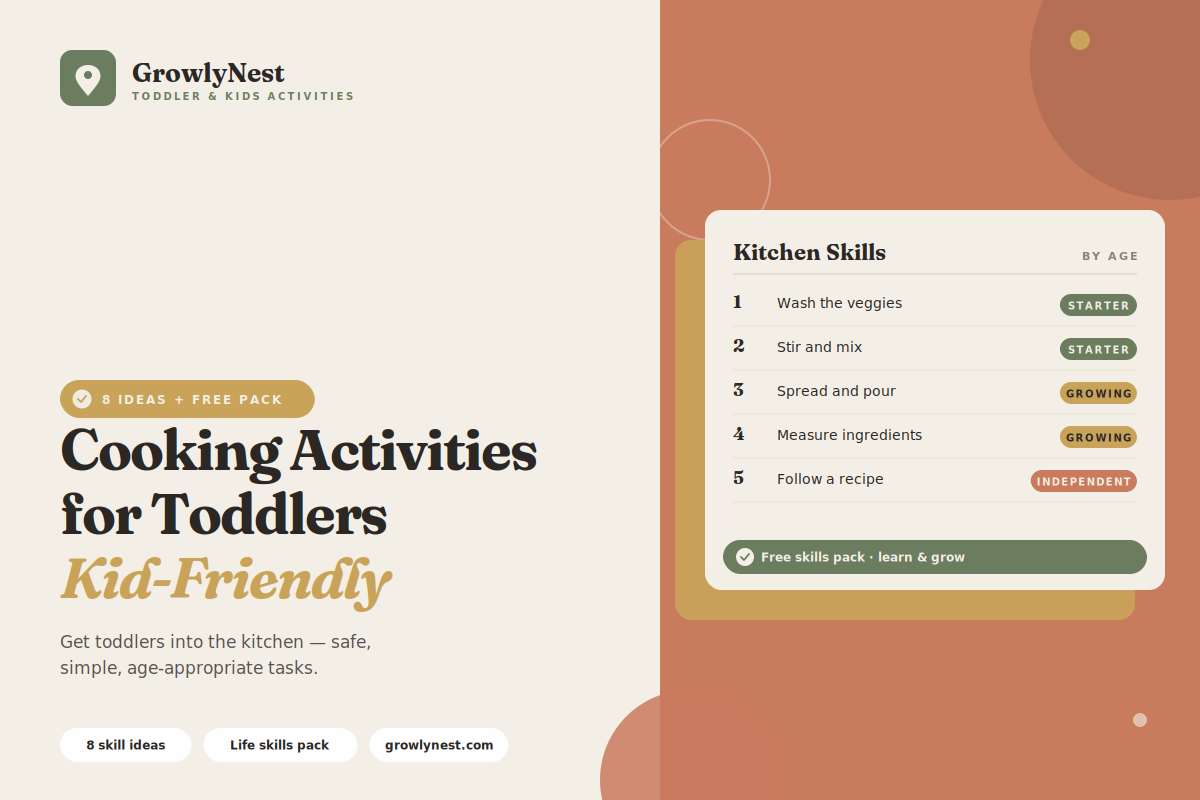
01. Around age 1-2: wash, stir, tear
The youngest helpers can wash fruit and vegetables in a bowl of water, stir cold ingredients, tear lettuce or herbs, and sprinkle toppings. These tasks are safe, sensory, and satisfying, and they plant the idea that your toddler belongs in the kitchen as a real helper.
02. Around age 2-3: pour, mash, spread
Two- and three-year-olds can pour pre-measured ingredients, mash soft foods like banana or potato, spread soft toppings with a blunt knife, and knead dough. These build hand strength and control, and produce results a child can proudly see and eat.
03. Around age 3-4: measure, mix, crack
Older toddlers can scoop and level measured amounts, mix more demanding batters, crack eggs (expect some shell at first), and assemble simple dishes like sandwiches or fruit kebabs on blunt sticks. They can also begin to follow a two- or three-step picture recipe.
04. Around age 4-5: follow a recipe, prep with a safe knife
Four- and five-year-olds can follow a short illustrated recipe with growing independence, use a child-safe knife to cut soft foods under supervision, set timers, and take charge of assembling a whole simple dish. This is real, confidence-building cooking.
Let them do it themselves — even when it's slower
That one mindset shift changes everything — and the free Life Skills & Independence Pack makes it doable. It includes an age-by-age skill guide for ages 1 to 5, a simple model → practice → step back framework, self-care checklists, an independence milestone tracker, and chores reframed as contribution.
Get the Free Life Skills PackSimple recipes and kitchen routines for toddlers
Beyond individual tasks, these approaches make cooking with a toddler genuinely workable.
05. Start with no-cook recipes
No-cook recipes — fruit kebabs, simple sandwiches, yoghurt-and-fruit pots, energy balls, a salad to toss — let a toddler do nearly every step safely themselves. They are the perfect starting point: real cooking, real pride, no heat involved.
06. Set up a low, safe kitchen station
Give your toddler a workable space — a sturdy step stool or a low table, their own bowl and blunt utensils, ingredients pre-portioned into small dishes. A set-up made for their size is what lets them genuinely participate rather than just watch.
07. Use a picture recipe
A simple recipe shown in pictures lets a toddler follow the sequence and feel in charge, building both independence and early literacy. Lay the steps out left to right and let your child 'read' the next step rather than waiting to be told.
08. Keep safety the constant rule
The adult always owns the hot stove, the oven, sharp knives, and any choking-risk foods, and supervision is hands-on throughout — never leave a toddler alone in the kitchen. Within those firm limits, let your toddler do as much as they safely can.
Tips for cooking with toddlers
1. Accept the mess as part of it
Flour on the counter and uneven stirring are what learning looks like. Lay down a wipeable mat, dress for mess, and let the kitchen be imperfect for a while.
2. Prep before you invite them in
Gather and pre-portion ingredients before your toddler joins, so the activity flows and the genuinely hazardous prep is already done by you.
3. Keep sessions short and pressure-free
A toddler's focus is brief. A short, happy cooking session beats a long one that ends in frustration — let them help with a few steps, not the whole marathon.
4. Let them eat what they make
The pride of eating their own creation is a powerful motivator and a boost for adventurous eating. Make recipes you'll genuinely all enjoy together.
Frequently asked questions
What cooking tasks are safe for toddlers?
Safe tasks include washing produce, stirring cold ingredients, tearing herbs, pouring pre-measured items, mashing soft foods, and spreading with a blunt knife. The adult always handles heat, sharp knives, and choking-risk foods, with close, hands-on supervision throughout.
Isn't cooking with a toddler too messy and slow?
It is messier and slower than cooking alone — and that mess and slowness are the learning happening. Each cooking session builds fine motor skills, maths, language and confidence. Choosing the slower path, with mess managed, is well worth it.
At what age can a toddler start helping cook?
Even one- to two-year-olds can help by washing produce, stirring, and tearing. Tasks then grow with age — pouring and mashing around 2 to 3, measuring and cracking eggs around 3 to 4, and following simple recipes around 4 to 5.
What are good first recipes to cook with toddlers?
Start with no-cook recipes — fruit kebabs, simple sandwiches, yoghurt and fruit pots, energy balls, or a salad to toss. These let a toddler do nearly every step themselves, safely, with real results to be proud of and no heat involved.
How do I keep my toddler safe in the kitchen?
Keep all heat, sharp knives, and choking-risk foods firmly to the adult, supervise hands-on at all times, and never leave a toddler alone in the kitchen. Give them a safe low station and match every task carefully to their age and ability.
The Life Skills & Independence Pack
Raise a capable, confident, independent child
Everything in one free download: the guide on the mindset shift of letting them do it themselves even when it's slower, an age-by-age skill guide for ages 1 to 5, a simple “how to teach a new skill” framework (model → practice → step back), self-care checklists, an independence milestone tracker, and chores reframed as contribution — for parents ready to move past “it's faster if I just do it myself.”
Download the Free Life Skills Pack →Free forever · No spam · Unsubscribe any time
From the GrowlyNest family — cheering you on as you raise a capable, confident, independent child, one slow and wobbly skill at a time.
You're getting — completely free
The Life Skills & Independence Pack
Here's how to get it
It arrives in 1–2 minutes — check your inbox now.
If you don't see the "Gift File" check your Promotions or Spam folder. Drag it to your main inbox so future emails reach you.
Loading Viewer...