
Daily Rhythm · Ages 1–4 · At-Home Days
Long days at home with a toddler can blur into a shapeless stretch of "what now?" — and that shapelessness is hard on toddlers and exhausting for parents. A daily schedule for a stay-at-home toddler gives those days an easy, happy rhythm. Here's a complete at-home daily schedule you can copy, plus how to make it genuinely work day to day.
Why a daily schedule helps at-home toddlers
Toddlers feel safest when they know what's coming, and a day with no shape leaves them unsettled and prone to meltdowns. A daily schedule gives a stay-at-home toddler the predictable rhythm they crave — a reliable flow of play, meals, learning, outdoor time, and rest. That structure isn't restrictive; it's reassuring. A toddler who knows the shape of the day is a calmer, more cooperative toddler.
A schedule helps the parent just as much. Long unstructured days are a recipe for decision fatigue and screen-time drift. A schedule means you're not constantly deciding what to do next — the day has a plan — and it ensures the toddler gets a genuine balance of active, calm, and learning-rich time. It should be a flexible rhythm, not a rigid timetable, and the strategies below help you keep it that way.
Free routine chart download
Get the Free Complete Kids Routine Chart Bundle
Includes the guide parents really need — how to get kids to actually follow the chart — plus morning, bedtime, after-school and chore charts, a routine builder worksheet to design your routine first, blank customisable versions, pre-reader picture cards, and travel and weekend troubleshooting.
Download the Free Routine Bundle →A sample daily schedule for a stay-at-home toddler
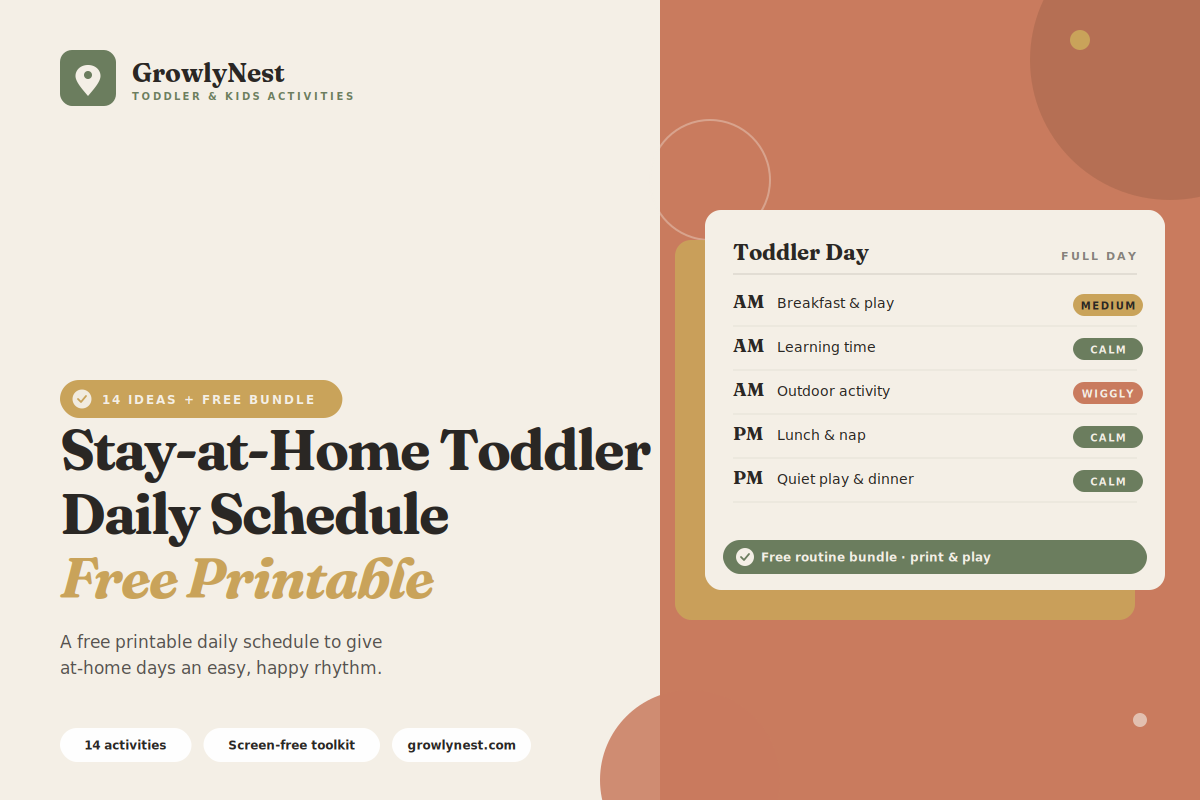
Here is a flexible full-day rhythm to copy and adapt. Treat it as an order of events, not a strict clock — toddlers need rhythm, not rigidity.
01. Wake, breakfast, and get dressed
Start the day with a calm, connected morning — breakfast together, then getting dressed. A gentle, predictable start sets the tone for the whole day.
02. Morning active play
A block of active, hands-on play while energy is high — building, movement, sensory play. Toddlers are at their best in the morning, so this is the natural slot for big play.
03. Morning snack and tidy-up
A snack and a quick tidy together. Building tidying into the rhythm makes it a normal habit rather than a battle.
04. Learning-rich activity
A focused activity — books, a craft, a puzzle, a simple learning game. A short, intentional learning slot gives the morning a productive anchor.
05. Outdoor time
Fresh air and movement, whatever the weather — the garden, a walk, the park. Outdoor time resets a toddler's mood and energy and is one of the most valuable parts of the day.
06. Lunch
A calm, shared lunch at a consistent time. The midday meal anchors the day and signals the wind-down toward nap is coming.
07. Nap or quiet time
A nap, or quiet rest time for toddlers who have dropped it. A predictable pre-nap routine makes this far smoother and protects everyone's afternoon.
08. Afternoon calm play and connection
After nap, gentler play and one-on-one time. Toddlers often need reconnection after sleep, so keep the afternoon calmer and more relaxed.
09. Afternoon snack and free play
A snack followed by child-led free play. Unstructured time is where toddlers do their richest, most imaginative play — it belongs in the schedule too.
10. Dinner and bedtime routine
A calm dinner, then into the bedtime wind-down. Ending the day with a consistent routine makes for calmer nights.
Struggling to get your child to follow the chart?
A chart on the wall is the easy part — getting kids to actually follow it is the real struggle. The free Complete Kids Routine Chart Bundle includes the step-by-step guide for exactly that, plus a routine builder worksheet, ready-made charts, pre-reader picture cards, and troubleshooting for travel and weekends.
Get the Free Routine BundleHow to make the daily schedule work
An at-home schedule should bring calm, not pressure. These strategies keep it realistic and effective.
11. Follow rhythm, not the clock
Use the schedule as an order of events rather than fixed times. Toddlers thrive on the predictable sequence; rigid timing only adds stress for everyone.
12. Make the schedule visible
Put the schedule up as a picture chart your toddler can see, and refer to it together — "what's next on our chart?" A visible schedule helps a toddler anticipate and cooperate.
13. Build in flexibility
Let the schedule flex for off days, weather, and the unexpected. A rhythm you can bend is a rhythm you'll actually keep; a rigid one collapses at the first disruption.
14. Alternate active and calm blocks
Notice how the schedule alternates lively play with calmer activities. This rhythm stops a toddler becoming overstimulated or under-stimulated and keeps the day balanced.
Tips for happier days at home
1. Don't fill every minute
A schedule needs breathing room. Leave space for free play and a little boredom — that's where toddlers invent their best, most imaginative play.
2. Keep meals and nap consistent
Even with a flexible schedule, keeping meals and nap at roughly the same times keeps a toddler's mood, hunger, and energy steady through the day.
3. Prepare activities in advance
Setting up the next activity while the current one runs keeps the day flowing and prevents the restless gaps that lead to meltdowns.
4. Adjust as your toddler grows
A schedule that fits a younger toddler will need updating as they grow, drop a nap, or change. Revisit and adjust the rhythm every few months.
Frequently asked questions
Do stay-at-home toddlers really need a daily schedule?
Toddlers genuinely benefit from a predictable daily rhythm — it helps them feel secure and reduces meltdowns. It should be a flexible flow of events rather than a rigid timetable, but the structure itself is valuable.
Should a toddler's daily schedule have set times?
It works better as a consistent order of events than a strict clock. Keeping meals and nap at roughly the same times helps, but the rest of the day should flow as a flexible rhythm.
How much structured activity does a stay-at-home toddler need?
A balance is best — some active play, a short learning activity, outdoor time, and meals as anchors, but with plenty of free, unstructured play too. Don't aim to fill every minute.
My toddler resists the schedule. What helps?
Make the schedule visible as a picture chart, refer to it together rather than directing, keep it flexible, and make sure it alternates active and calm time. Resistance often eases when the toddler can see the rhythm and it genuinely fits their needs.
What if our day doesn't go to plan?
That's completely normal — simply pick the rhythm back up at the next point. A schedule is there to reduce stress and give the day shape, not to be followed perfectly. Flexibility is part of what makes it work.
The Complete Kids Routine Chart Bundle
A routine that actually sticks
Everything in one free download: the guide to getting kids to actually follow the chart, morning, bedtime, after-school and chore charts, a routine builder worksheet to design your routine first, blank customisable versions, pre-reader picture cards, and troubleshooting for travel and weekends.
Download the Free Routine Bundle →Free forever · No spam · Unsubscribe any time
From the GrowlyNest family — helping you build calm, predictable routines your children genuinely follow.
You're getting — completely free
The Complete Kids Routine Chart Bundle
Here's how to get it
It arrives in 1–2 minutes — check your inbox now.
If you don't see the "Gift File" check your Promotions or Spam folder. Drag it to your main inbox so future emails reach you.
Loading Viewer...