
Gentle Parenting · Scripts · What to Say
You can hear it happening — your voice climbing, getting sharper, and a part of you watching from the outside thinking "I don't want to be shouting." Almost every parent knows that feeling. The thing is, in the heat of the moment, yelling is often just the words that arrive first. This article gives you gentle parenting phrases to use instead of yelling — calm, ready-made words to reach for when your own go blank.
Why we yell — and why phrases help
Yelling is rarely a choice a parent makes calmly; it's what happens when a stressed brain reaches for whatever is most familiar. When your toddler does something that lands like a jolt, your own stress response fires, and in that flooded state the thoughtful, patient part of your brain goes partly offline. Many parents then fall back on the words they grew up hearing — even words they swore they'd never use. That isn't a character flaw or a sign you're failing. It's a predictable human response, and naming it without shame is the first step to changing it.
Prepared phrases work because they do the thinking in advance. When you've rehearsed a calm phrase enough times, it becomes the familiar thing your brain reaches for in the heated moment — instead of a shout. This isn't about being fake, robotic, or endlessly serene; gentle parenting still holds firm limits, and a calm phrase can be every bit as firm as a yell. The phrases below let you be clear and boundaried without the volume. One honest note: a phrase said through gritted teeth sends a different message than the same words said warmly — the calm tone is what makes them land. And when you do yell anyway, because every parent sometimes does, you simply repair. Progress, not perfection.
Free printable download
Get the Free Gentle Parenting Scripts Pack
A guide on what gentle parenting actually is — and isn't — that clears up the permissive confusion, plus printable scripts for the real daily flashpoints (tantrums, hitting, biting, not listening, sharing, transitions, public meltdowns, the word “no”), a one-page fridge quick-reference, repair scripts for after you lose it, and a parent calm-down toolkit.
Download the Free Scripts Pack →Phrases for setting limits calmly
These hold a boundary firmly while keeping your voice calm — firm is not the same as loud.
01. "I won't let you..."
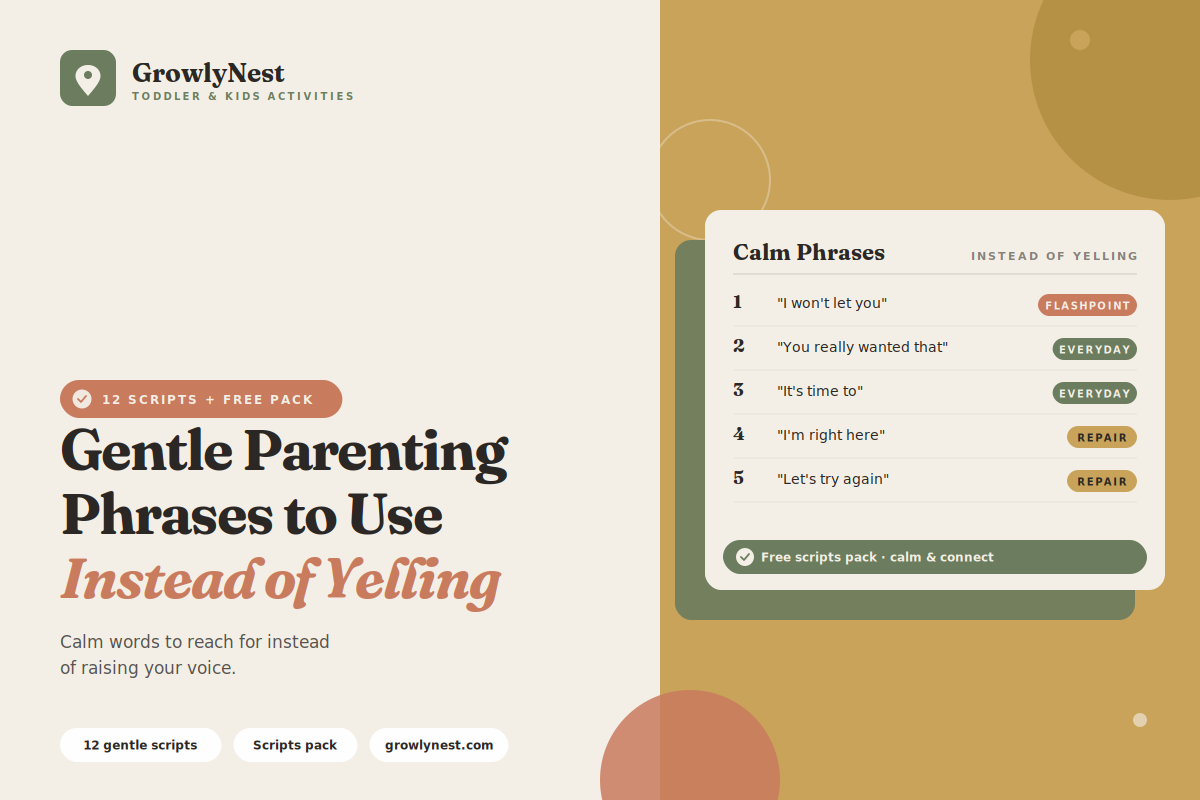
For anything unsafe or hurtful, this states the limit clearly while keeping you the calm one in charge: "I won't let you hit." "I won't let you throw that." It puts the responsibility on you to keep everyone safe, rather than ordering the child to stop — and you pair it with calmly doing exactly that.
02. "It's time to..."
For transitions and non-negotiables, a calm statement beats a question that invites a "no": "It's time to put shoes on." "It's time to leave the park." Said warmly but without apology, it frames the limit as simply what happens next — not something to debate or shout about.
03. "You can... or you can..."
When you want cooperation, offer two choices you can both live with: "You can walk to the car, or hop like a bunny to the car." The limit holds; your toddler gets real control over the how. A choice often dissolves the standoff that would otherwise have you raising your voice.
04. "I'm going to help you"
When a toddler won't do a needed thing, this replaces an escalating order with calm follow-through: "It's time to go — I'm going to help you." You then gently and kindly help them do it. It's firm and final, but it's matter-of-fact rather than a threat shouted across the room.
Phrases for big feelings
These help a child feel understood — and help you stay calm by reminding you what's really going on.
05. "You really wanted..."
Naming the wish behind the upset shows your toddler you truly get it: "You really wanted to keep playing." "You really wanted the blue cup." Feeling understood is what helps a feeling settle — and saying it out loud also reminds you that this is a small person with a big disappointment, which makes calm easier.
06. "You're feeling... and that's okay"
This names the emotion and permits it: "You're feeling so angry, and that's okay." "You're sad it's over — that's allowed." It teaches the foundational lesson that all feelings are acceptable, even the big uncomfortable ones, which is what eventually helps a child manage them.
07. "It's so hard when..."
A warm phrase for disappointment and frustration: "It's so hard when we have to stop something fun." "It's so hard to wait." It sits alongside your child in the difficulty instead of dismissing it with "you're fine," and that companionship soothes an upset toddler.
08. "I'm right here"
Sometimes the calmest, most powerful phrase is the simplest. "I'm right here." "You're safe, and I'm staying with you." When a child is too dysregulated for other words to land, this offers the one thing they most need — the steady presence of their person.
Never stuck for what to say again
The free Gentle Parenting Scripts Pack gives you calm, kind words ready for every hard moment — printable scripts for tantrums, hitting, not listening, sharing, transitions and more, a one-page fridge quick-reference, repair scripts for after you lose it, and a parent calm-down toolkit.
Get the Free Scripts PackPhrases for connection and repair
These rebuild closeness — including after you're the one who slips and yells.
09. "Let's try that again"
The do-over phrase gives a calm second chance to practise the right way, without shame: "That came out as a grab — let's try again, can you ask for a turn?" It treats a mistake as practice, which is exactly how gentle parenting sees it.
10. "I'm sorry I shouted. That wasn't okay"
When you do yell, this is your repair phrase: "I'm sorry I shouted. That wasn't okay, and it wasn't your fault." Owning your part simply models accountability and reassures your child the relationship is safe even after a rupture. Repair is what makes the occasional yell something your child can recover from.
11. "Let's take a breath together"
An invitation that calms two nervous systems at once: "This is a big feeling — let's take a slow breath together." It gives you both something calming to do instead of escalating, and over time it teaches your toddler a self-soothing tool they can use anywhere.
12. "I love you, even when..."
A reassurance phrase for after hard moments: "I love you, even when you're angry." "My love doesn't go anywhere, even on tricky days." It tells your child your love is unconditional and not something they can lose by having a hard time — the security all the rest is built on.
Tips for replacing yelling with calm phrases
1. Practise the phrases when everyone is calm
Rehearse a few out loud during quiet moments, even when it feels silly. A phrase you've actually said before is far easier for your brain to find under pressure than one you've only read.
2. Tone matters more than the exact words
A phrase said through gritted teeth sends a completely different message than the same words said warmly. The calm tone is what replaces the yell — the words are the scaffold for it.
3. Notice your own warning signs
Yelling has a build-up — a clenched jaw, a rising chest, a particular thought. Learning your own signs lets you catch yourself and reach for a phrase before the shout arrives.
4. Repair when you yell anyway — and let the guilt go
You will still yell sometimes, and it doesn't undo your good parenting. Repair simply, then set the guilt down. A parent who yells and repairs is teaching something valuable: that ruptures can be mended.
Frequently asked questions
Do gentle parenting phrases feel fake or robotic?
They can feel stiff at first — that's the normal awkwardness of any new skill. With practice they become natural and genuinely yours, especially once you adapt the wording into your own voice. The slight initial awkwardness is well worth the calmer responses they make possible.
Is it bad that I yell at my toddler?
Yelling sometimes is human — every parent does it, usually while tired and stretched thin — and it does not undo your good parenting or your bond. What matters most is reducing it over time and repairing when it happens. Be as compassionate with yourself as you'd be with a friend.
Why does my tone matter so much?
Young children read tone, face, and body language far more than words. The same phrase delivered warmly versus harshly carries opposite messages. A calm tone is what tells your child they're safe — which is exactly what you're aiming for instead of a yell.
Are calm phrases just as firm as yelling?
Yes — firmness comes from clarity and follow-through, not volume. "I won't let you hit," said calmly and backed by gently stopping the hit, is completely firm. Yelling often signals a parent feels out of control; a calm, clear phrase signals steady authority.
How do I stop yelling when I'm already worked up?
Notice your warning signs early, pause and take one slow breath, lower your voice on purpose, and reach for a rehearsed phrase. If you can, step back briefly while your child is safe. And if you yell anyway, repair afterwards — reducing it over time is the realistic goal.
The Gentle Parenting Scripts Pack
Calm, kind words for every hard moment
Everything in one free download: a guide on what gentle parenting actually is and isn't, printable scripts for the real daily flashpoints — tantrums, hitting, biting, not listening, sharing, transitions, public meltdowns, the word “no” — a one-page fridge quick-reference, repair scripts for after you lose it, and a parent calm-down toolkit.
Download the Free Scripts Pack →Free forever · No spam · Unsubscribe any time
From the GrowlyNest family — cheering you on as you parent with empathy and firm, loving boundaries. You're doing a hard job, and doing it with care.
You're getting — completely free
The Gentle Parenting Scripts Pack
Here's how to get it
It arrives in 1–2 minutes — check your inbox now.
If you don't see the "Gift File" check your Promotions or Spam folder. Drag it to your main inbox so future emails reach you.
Loading Viewer...