
Gentle Parenting · Tantrums · Big Feelings
It's 5pm, your toddler is screaming on the kitchen floor because their banana broke in half, and every "gentle parenting" idea you've ever read has just evaporated from your mind. If that's you, take a breath — you are in good company, and you are not doing it wrong. Here are gentle parenting tips for toddler tantrums that actually work: calm, practical, and with no judgement and no perfection required.
Why toddlers have tantrums
Tantrums are not a sign of bad parenting or a "difficult" child — they are a normal, universal, and developmentally expected part of toddlerhood. A toddler's brain is under rapid construction, and the part that manages big emotions and impulses, the prefrontal cortex, is years away from mature. When a toddler is flooded by frustration, disappointment, tiredness, or hunger, they genuinely cannot "calm down" or "use their words," because the brain machinery for that simply isn't built yet. A tantrum is a small nervous system overflowing — not a choice, not manipulation, and not something your child can switch off on demand.
This is why the gentle parenting approach to tantrums is not to punish them, shut them down by force, or ignore the child until they're "reasonable." And here's the part that gets misunderstood: responding gently is not permissive. Gentle parenting treats a tantrum as a moment to support a child through a feeling that is too big for them — while still calmly holding whatever limit triggered it. You are not rewarding the tantrum by staying kind; you're teaching your child that big feelings are survivable and that you are a safe, steady harbour when they hit. Empathy for the feeling and firmness on the limit happen together — that combination is the heart of it.
Free printable download
Get the Free Gentle Parenting Scripts Pack
A guide on what gentle parenting actually is — and isn't — that clears up the permissive confusion, plus printable scripts for the real daily flashpoints (tantrums, hitting, biting, not listening, sharing, transitions, public meltdowns, the word “no”), a one-page fridge quick-reference, repair scripts for after you lose it, and a parent calm-down toolkit.
Download the Free Scripts Pack →What to do during a tantrum
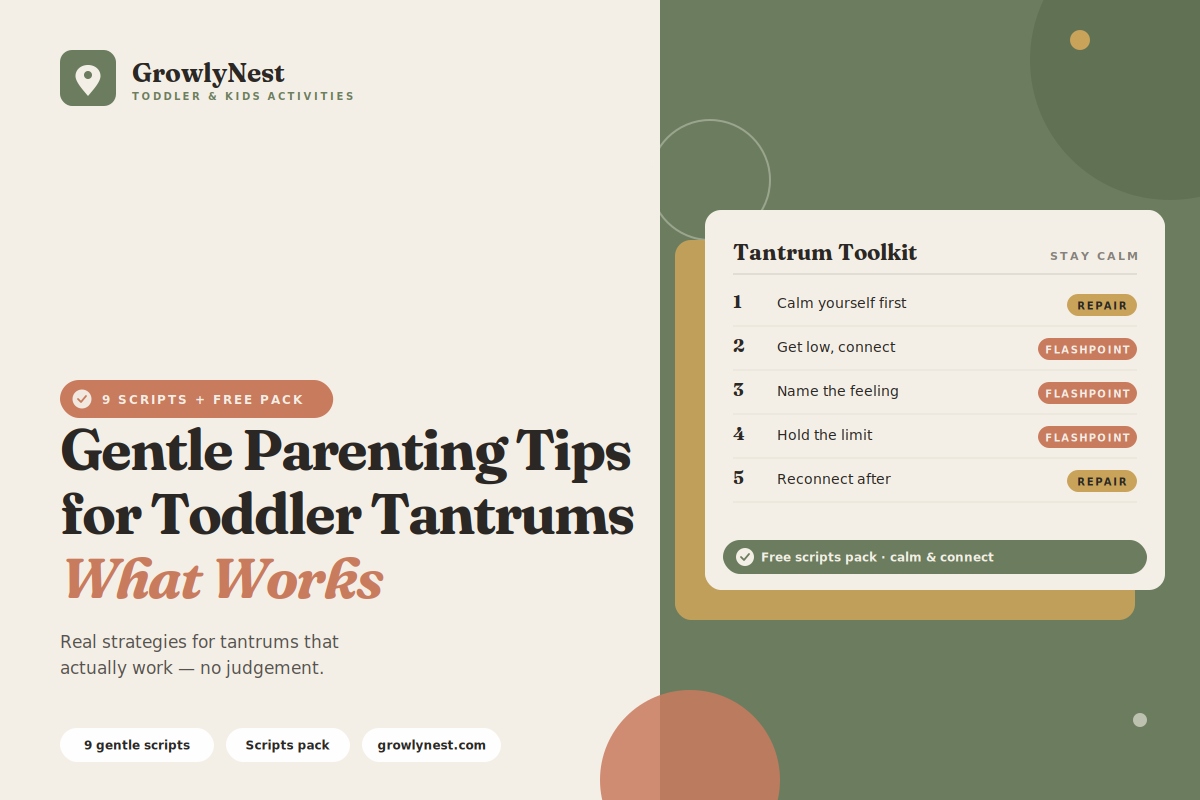
In the heat of a tantrum, gentle parenting follows a clear sequence — each step matters.
01. Regulate yourself first
Before you can help your toddler, steady your own nervous system — a slow breath, dropped shoulders, a lower voice. A tantrum can trigger a stress response in you too, and two dysregulated people only escalate. Your calm isn't a nice extra here; it's the foundation. Tell yourself: "This is hard, but it's not an emergency."
02. Get low and stay close
Come down to your toddler's physical level and stay near in a calm, unhurried way. Looming over a child adds to the overwhelm; getting low signals safety and partnership. You don't need to fix anything yet — your steady, close presence is itself the intervention. Some toddlers want a cuddle; others need a little space but to still see you there.
03. Name the feeling simply
Put short, calm words to what your toddler feels: "You're so angry." "You really wanted that." "It's so hard when we have to stop." Keep it brief — a dysregulated child can't process a speech. Naming the feeling helps a child feel understood and slowly builds the emotional vocabulary that makes tantrums less frequent over time.
04. Hold the limit, calmly and kindly
If the tantrum is about a limit, keep the limit — calmly, without lecturing, and without caving. "I know you want the sweets. They're not for now." Giving in mid-tantrum to stop the noise teaches a child that big feelings are how you change a "no." You can be deeply empathetic and completely immovable on the boundary at the same time.
05. Let the feeling run its course
A tantrum is a wave of feeling that needs to crest and pass — you cannot reason it away or rush it. Once you've connected and held the limit, your job is mostly to stay calm and present while the storm moves through, keeping everyone safe. Resist the urge to keep talking. Your steady presence says: this feeling is big, but it will pass, and I'm here the whole time.
Never stuck for what to say again
The free Gentle Parenting Scripts Pack gives you calm, kind words ready for every hard moment — printable scripts for tantrums, hitting, not listening, sharing, transitions and more, a one-page fridge quick-reference, repair scripts for after you lose it, and a parent calm-down toolkit.
Get the Free Scripts PackWhat to do before and after tantrums
Much of tantrum management happens outside the tantrum itself — in prevention and repair.
06. Reduce the common triggers
Many tantrums are fuelled by tiredness, hunger, overstimulation, or too many transitions. You won't prevent them all, but you can lower the load: protect naps and snacks, build in downtime, and warn before changes. A well-rested, well-fed toddler still has tantrums — just noticeably fewer.
07. Reconnect warmly afterwards
When the tantrum has passed, reconnect without making your toddler pay an emotional price — a cuddle, a kind look, a gentle "that was a big feeling, and it's over now." No lecture, no forced apology. Reconnection teaches your child they are still loved and safe after a hard moment, which helps them recover faster next time.
08. Teach calming skills at calm times
The middle of a tantrum is no time to teach coping skills — but calm, ordinary moments are. Play with deep breaths, name feelings in stories, and talk about what helps when we're upset. Skills practised when calm slowly become tools a child can reach for when they're not.
09. Notice your own patterns and limits
Tantrums are genuinely depleting, and you'll handle them better some days than others — that's human. Notice when your own tank is low, tag in a partner where you can, and let go of guilt on the harder days. Caring for your own regulation is part of the strategy, not separate from it.
Tips for handling tantrums gently
1. Remember a tantrum is not an emergency
The screaming can feel urgent and unbearable, but a tantrum is a normal feeling running its course — not a crisis. Telling yourself "this is hard, not dangerous" helps you stay the calm anchor your toddler needs.
2. Don't take it personally
A tantrum is your toddler's overwhelm spilling over, not a verdict on you or a sign they don't love you. They melt down with you precisely because you are their safe person. It is not a personal attack.
3. Hold limits and feelings together
The two-part move is everything: fully accept the feeling ("you're so upset") and calmly keep the limit ("and it's still time to go"). Empathy without the boundary becomes permissive; the boundary without empathy becomes harsh.
4. Let go of perfection and judgement
You will handle some tantrums beautifully and others badly — that is parenting, not failure. Drop the imagined judgement of onlookers and the harsh judgement of yourself. A calm-enough response, most of the time, is genuinely good parenting.
Frequently asked questions
Should I ignore my toddler's tantrums?
Gentle parenting doesn't recommend ignoring a child mid-tantrum — a dysregulated toddler needs calm support, not withdrawal. You can stay close and connected without giving in to the demand. Holding the limit is firm; ignoring the child is something different, and it tends to leave the feeling unmet.
Am I rewarding the tantrum by comforting my child?
Comforting a child through a feeling is not the same as giving in to a demand. You can offer warmth and connection ("I'm here, this is hard") while completely holding the limit that triggered the tantrum. You reward a tantrum only by changing your "no" — not by being kind.
Does gentle parenting actually work for tantrums?
Gentle parenting is a long-term approach focused on building skills — emotional regulation, cooperation — rather than producing instant silence through fear. It generally won't end a tantrum faster than a threat might, but it builds the underlying capability over time. Judge it across months, not single moments.
How long do toddler tantrums last?
Most tantrums pass within a few minutes once the wave of feeling crests, though it can feel far longer. Trying to reason a child out of a tantrum or rushing it tends to extend it. Staying calm and letting the feeling run its course is usually the fastest route through.
When should I be concerned about tantrums?
Tantrums are a normal part of toddlerhood. It can be worth a chat with your doctor or health visitor if tantrums are extremely frequent and intense well beyond the toddler years, regularly involve hurting themselves or others, or last a very long time — not because you've done anything wrong, but because extra support is always available.
The Gentle Parenting Scripts Pack
Calm, kind words for every hard moment
Everything in one free download: a guide on what gentle parenting actually is and isn't, printable scripts for the real daily flashpoints — tantrums, hitting, biting, not listening, sharing, transitions, public meltdowns, the word “no” — a one-page fridge quick-reference, repair scripts for after you lose it, and a parent calm-down toolkit.
Download the Free Scripts Pack →Free forever · No spam · Unsubscribe any time
From the GrowlyNest family — cheering you on as you parent with empathy and firm, loving boundaries. You're doing a hard job, and doing it with care.
You're getting — completely free
The Gentle Parenting Scripts Pack
Here's how to get it
It arrives in 1–2 minutes — check your inbox now.
If you don't see the "Gift File" check your Promotions or Spam folder. Drag it to your main inbox so future emails reach you.
Loading Viewer...