
Homework · Ages 5–10 · Study Habits
Homework battles are exhausting for everyone — the resisting, the distractions, the negotiation. Often the real problem isn't the homework itself but the lack of a clear, predictable routine around it. A homework routine chart turns homework from a nightly fight into a known, manageable part of the day. Here's a complete homework routine, plus how to get your child to actually follow it.
Why a homework routine chart helps
Most homework resistance comes down to transitions and predictability. Asking a child to drop their play and switch into focused work, with no clear structure, is a hard ask — and the open-ended "do your homework" gives them nothing to hold onto. A homework routine chart solves this by making homework a predictable, visible part of the afternoon, with a clear before and after. The child knows it's coming, knows what it involves, and knows free time follows.
A routine also builds the genuine skill of study habits — clearing a space, settling to focused work, checking and packing — which serves a child far beyond any single homework task. And it removes you from the role of nightly enforcer, because the routine, not your nagging, drives the process. The strategies below ensure the chart is actually followed rather than just admired on the wall.
Free routine chart download
Get the Free Complete Kids Routine Chart Bundle
Includes the guide parents really need — how to get kids to actually follow the chart — plus morning, bedtime, after-school and chore charts, a routine builder worksheet to design your routine first, blank customisable versions, pre-reader picture cards, and travel and weekend troubleshooting.
Download the Free Routine Bundle →A sample homework routine
Here is a calm, copyable homework sequence. The principle: prepare the body and the space before expecting focus.
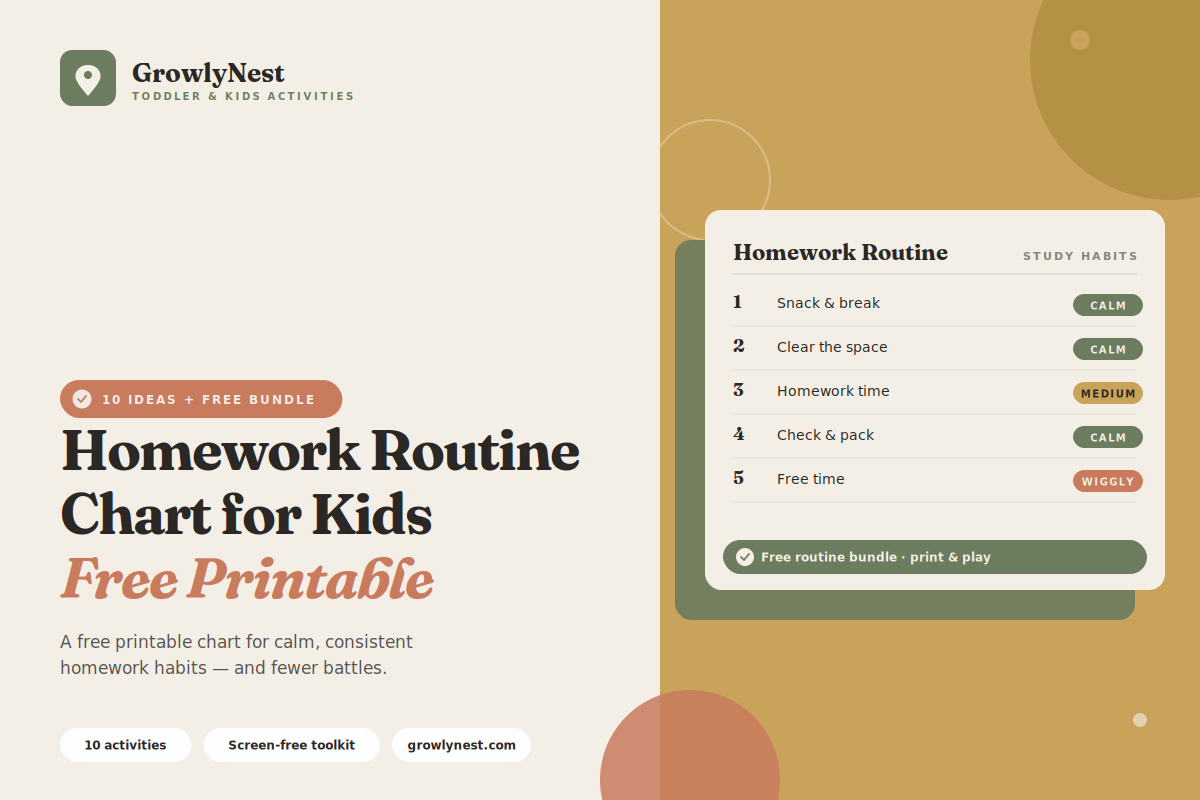
01. Snack and a short break
Begin with a snack and genuine downtime after school. A hungry, depleted child cannot focus — refuelling first is the foundation of a workable homework routine.
02. Some active movement
A short burst of active play or outdoor time before homework. Movement after a day of sitting helps a child settle and concentrate far better than going straight to the desk.
03. Clear and set up the space
Tidy the table, gather pencils and supplies, and remove distractions. Setting up the space is a calming transition step that signals it's time to focus.
04. Homework time
The focused work itself, in a consistent spot. Keeping homework in the same place at roughly the same time each day builds the habit and reduces the daily resistance.
05. Check and pack the bag
Once homework is done, check it over together and pack it straight into the school bag. This builds responsibility and prevents the morning scramble for missing work.
06. Free time as the reward
A clear block of free time once homework is finished. Knowing free time follows gives a child a real, motivating reason to settle to the work.
Struggling to get your child to follow the chart?
A chart on the wall is the easy part — getting kids to actually follow it is the real struggle. The free Complete Kids Routine Chart Bundle includes the step-by-step guide for exactly that, plus a routine builder worksheet, ready-made charts, pre-reader picture cards, and troubleshooting for travel and weekends.
Get the Free Routine BundleHow to get your child to follow the homework chart
A homework chart only ends the battles if your child genuinely follows it. These strategies make that happen.
07. Don't skip the decompression steps
The snack, break, and movement steps are not optional padding — they are what make focus possible. Jumping straight to homework is the most common reason homework routines fail.
08. Let the chart hold the expectation
Refer to the chart — "the chart shows homework now, then free time" — rather than nagging. The routine becomes the authority, so homework isn't a nightly fight between you and your child.
09. Keep homework time consistent
Do homework at roughly the same time and place each day. Consistency turns homework into an automatic habit rather than a daily decision to resist.
10. Build the routine with your child
Let your child help decide when homework falls and what their workspace looks like. A child who shaped the routine is far more invested in following it.
Tips for calmer homework time
1. Match the timing to your child
Some children focus best straight after a snack and movement; others need a longer break first. Watch your child and place homework where their focus is genuinely at its best.
2. Keep the workspace consistent and calm
A consistent, tidy, low-distraction spot for homework helps a child settle. The same place each day becomes a cue for focus.
3. Be available without taking over
Stay nearby to help if needed, but let the work be your child's. Hovering or doing it for them undermines the independence the routine is building.
4. Keep sessions age-appropriate
Young children can only focus for short stretches. Keep homework time realistic for your child's age, with breaks if needed, rather than pushing for a long unbroken session.
Frequently asked questions
What age is a homework routine chart for?
Homework routine charts suit children from around age 5, when school homework typically begins, through to about age 10. Younger children will have a shorter, simpler routine; older children can take more ownership.
When is the best time for homework after school?
For most children, after a snack, some downtime, and a burst of active movement — not the moment they walk in the door. Watch your own child, as some need a longer break before they can focus.
My child resists homework every single day. What helps?
Make sure the snack, break, and movement steps aren't being skipped, keep homework at a consistent time and place, refer to the chart rather than nagging, and let your child help shape the routine. Resistance often eases when the routine respects how tired they are.
Should I sit with my child during homework?
Stay nearby and available to help, but let the work be theirs. Children build study independence by doing the work themselves — your role is support, not taking over.
How long should homework take?
It depends on age and the work set, but young children can only concentrate for short periods. Keep homework time realistic for your child's age, and use short breaks rather than pushing through a long, frustrating session.
The Complete Kids Routine Chart Bundle
A routine that actually sticks
Everything in one free download: the guide to getting kids to actually follow the chart, morning, bedtime, after-school and chore charts, a routine builder worksheet to design your routine first, blank customisable versions, pre-reader picture cards, and troubleshooting for travel and weekends.
Download the Free Routine Bundle →Free forever · No spam · Unsubscribe any time
From the GrowlyNest family — helping you build calm, predictable routines your children genuinely follow.
You're getting — completely free
The Complete Kids Routine Chart Bundle
Here's how to get it
It arrives in 1–2 minutes — check your inbox now.
If you don't see the "Gift File" check your Promotions or Spam folder. Drag it to your main inbox so future emails reach you.
Loading Viewer...