
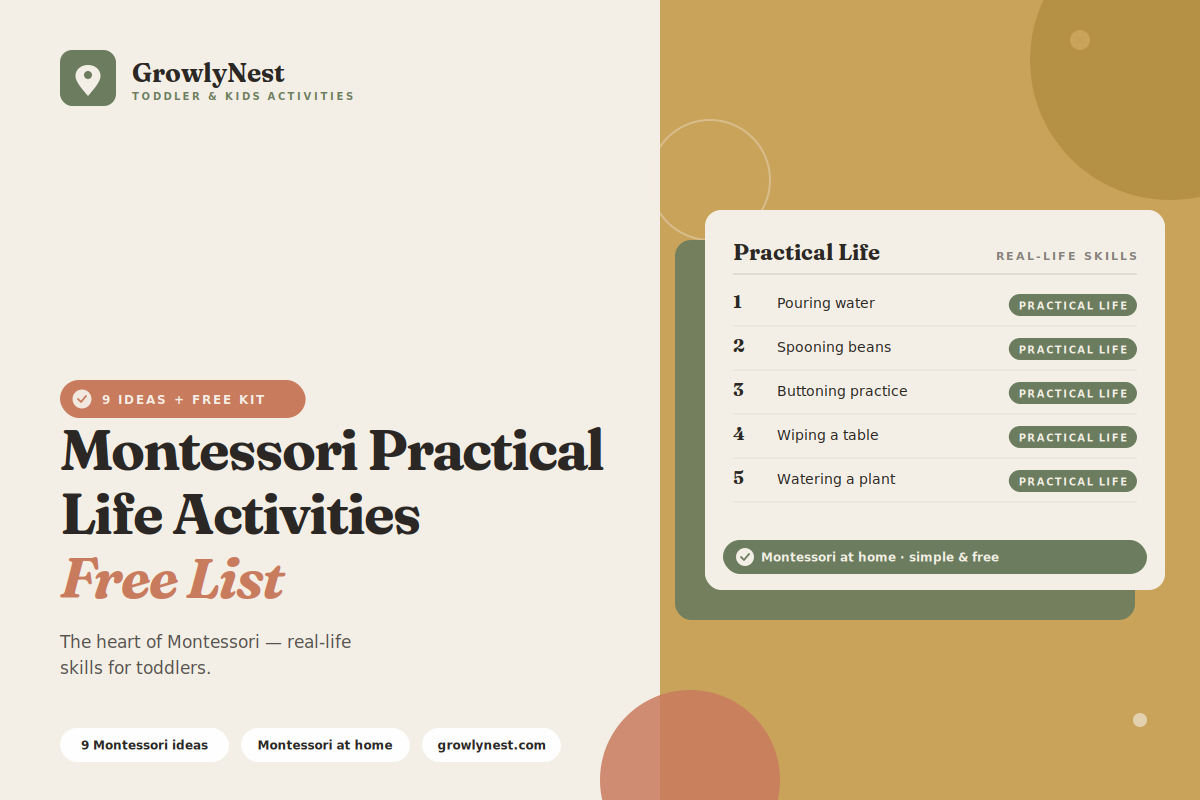
Montessori · Practical Life · Independence
If you only ever explored one area of Montessori with your toddler, this would be the one. Montessori practical life activities — pouring, wiping, dressing, caring for the home — are often called the heart of the whole approach. They're also the easiest, cheapest place to start, because they use exactly what's already in your home. Here's your practical guide.
Why practical life is the heart of Montessori
Practical life activities are the real-world tasks of everyday living — pouring a drink, wiping a spill, buttoning a coat, watering a plant, preparing a snack. In Montessori, these are not chores to get through but genuine, valuable "work" for a toddler, and they're considered foundational for good reason. Practical life builds concentration and focus, develops fine and gross motor coordination, teaches sequencing and the satisfaction of completing a task, and — above all — builds the independence and confidence that come from a child knowing "I can do real things myself." Toddlers are naturally, powerfully drawn to this work; that intense desire to pour their own water and sweep their own crumbs is a developmental drive, and practical life meets it beautifully.
Practical life is also the perfect answer to the biggest worry parents have about Montessori — that it requires expensive materials and a perfect set-up. It requires neither. Practical life activities are built entirely from real household objects you already own: a small jug, a sponge, a child-sized brush, real cutlery, a low basket. There is nothing to buy. The "prepared environment" for practical life is simply making everyday tasks accessible to small hands — a low hook, a reachable cloth, a step stool. This is Montessori at its most genuine and most affordable: not a shopping list, but a shift in how you let your toddler take part in real life. Start here, with what you have, and you've started Montessori for real.
Free Montessori starter kit
Get the Free Montessori-at-Home Starter Kit
Everything you need to start Montessori at home — without the perfect shelf or expensive materials. The kit includes the guide to doing Montessori on a real budget, a plain-English “what is Montessori, really?” primer, DIY tray printables, Montessori shelf labels, a finder by skill area, and an observation and progress tracker.
Download the Free Starter Kit →Montessori practical life activities by area
Practical life falls into a few natural groups. All of these use ordinary household objects.
01. Pouring and transferring
Pouring water between small jugs, spooning beans between bowls, transferring pom-poms with tongs — these classic activities build hand control, concentration, and coordination. Start with easy transfers (a big spoon, dry items) and progress to pouring water.
02. Care of self
Activities where your toddler cares for their own body and belongings — washing hands, brushing hair, dressing, putting on shoes, blowing their nose. Care of self builds the everyday independence toddlers are desperate to claim.
03. Care of the environment
Tasks that care for the shared space — wiping a table, sweeping with a small brush, watering plants, dusting, tidying up. Care of the environment teaches responsibility and the satisfying sense of contributing to the home.
04. Food preparation
Simple, supervised food tasks — spreading, slicing a banana with a child-safe knife, peeling a satsuma, washing fruit. Food prep is engaging, useful practical-life work and a wonderful way to involve a toddler in real family life.
05. Fine motor practical work
Activities that refine small-hand control — opening and closing containers, using clothes pegs, threading, fastening buttons and zips. These build the precise coordination that later supports writing and self-care.
No perfect shelf. No expensive materials. Just start.
The free Montessori-at-Home Starter Kit removes the biggest barrier keeping parents out — the belief that you need a costly set-up. Inside: a “what is Montessori, really?” primer, DIY tray printables, shelf labels, a finder by skill area, and a progress tracker.
Get the Free Starter KitHow to set up practical life at home
Practical life works best with a little thoughtful set-up — and none of it costs anything.
06. Show the activity slowly first
Before your toddler tries an activity, demonstrate it slowly and silently, breaking it into clear steps. This Montessori-style demonstration shows a child exactly how the work goes, far better than verbal instruction alone.
07. Use real, child-sized objects
Practical life uses real tools, just small — a real little jug that really pours, a real cloth, real cutlery. Genuine objects (sized for small hands) let a toddler do real work, which is what makes the activity meaningful.
08. Make it accessible and let them repeat
Keep practical-life activities where your toddler can reach and choose them, and let them repeat an activity as many times as they wish — repetition is how a child perfects a skill and is never "too much."
09. Allow the mess and the slowness
Practical life done by a toddler is slow and imperfect — water spills, crumbs scatter. That's the learning. Allow extra time, keep a cloth handy for your toddler to clean up themselves, and resist taking over.
Tips for Montessori practical life
1. Use what's in your kitchen
Practical life needs no special materials — jugs, bowls, spoons, sponges, and cloths from your own kitchen are perfect. There's nothing to buy.
2. Demonstrate slowly and silently
Show an activity slowly, step by step, before your toddler tries. A clear, calm demonstration teaches better than words.
3. Welcome repetition
Let your toddler repeat an activity over and over. Repetition is how a child masters a skill — it's never excessive.
4. Allow the mess
Spills and crumbs are practical life in progress. Allow time, keep a cloth handy for your child, and let imperfect work stand.
Frequently asked questions
What are Montessori practical life activities?
Practical life activities are the real-world tasks of everyday living — pouring, transferring, dressing, wiping, sweeping, watering plants, simple food prep. In Montessori they are valuable "work" that builds concentration, coordination, and independence.
Why is practical life so important in Montessori?
Practical life is considered the heart of Montessori because it builds concentration, coordination, sequencing, and — most of all — the independence and confidence of a child doing real things themselves. Toddlers are naturally, powerfully drawn to this work.
Do practical life activities need special materials?
No — practical life is the most affordable part of Montessori. The activities use real household objects you already own: small jugs, bowls, spoons, sponges, cloths, child-safe cutlery. There is genuinely nothing to buy.
What age are practical life activities for?
Practical life suits toddlers from around age 1, with activities growing in difficulty through the toddler and preschool years. Start with simple transfers and self-care, and progress as your child's coordination and interest grow.
How do I introduce a practical life activity?
Demonstrate the activity slowly and silently first, breaking it into clear steps so your toddler sees exactly how it works. Then step back and let them try, allowing repetition, mess, and slowness. Use real, child-sized objects throughout.
The Montessori-at-Home Starter Kit
Start Montessori at home — the simple, affordable way
Everything in one free download: the guide to Montessori at home without the perfect shelf or expensive materials, a “what is Montessori, really?” primer, DIY tray printables, Montessori shelf labels, a finder by skill area (practical life, sensorial, language, maths), and an observation and progress tracker. Start today, with what you already have.
Download the Free Starter Kit →Free forever · No spam · Unsubscribe any time
From the GrowlyNest family — helping you bring calm, capable, child-led learning into your home, no perfect shelf required.
You're getting — completely free
The Montessori-at-Home Starter Kit
Here's how to get it
It arrives in 1–2 minutes — check your inbox now.
If you don't see the "Gift File" check your Promotions or Spam folder. Drag it to your main inbox so future emails reach you.
Loading Viewer...