Home Learning · Ages 3–5 · Preschool Skills
"Preschool at home" can sound daunting — as though you need a curriculum, a classroom, and a teaching qualification. You don't. Preschool activities at home are really just playful experiences that build the skills behind school readiness, and most of them look like ordinary fun. Here are 12 preschool activities that genuinely prepare a child for school, with no pressure and no special training needed.
What preschoolers really need — and what can wait
Here's something that surprises many parents: school readiness has very little to do with knowing letters and numbers. What truly prepares a child for school is the foundation underneath — language and communication, the ability to focus and follow instructions, fine motor strength, independence and self-care, social skills, emotional regulation, and above all curiosity and confidence. These are the things preschool activities should nurture, and they're built through play.
So if you're worried your preschooler should be reading or doing sums, please relax — those can wait, and pushing them early rarely helps. The activities below build the genuine school-readiness skills through playful, hands-on experiences you can fit into normal days. There's no need to recreate a classroom or follow a strict programme. Follow your child, keep it joyful, and trust that play is doing the work.
Free home learning download
Get the Free Home Learning Starter Kit
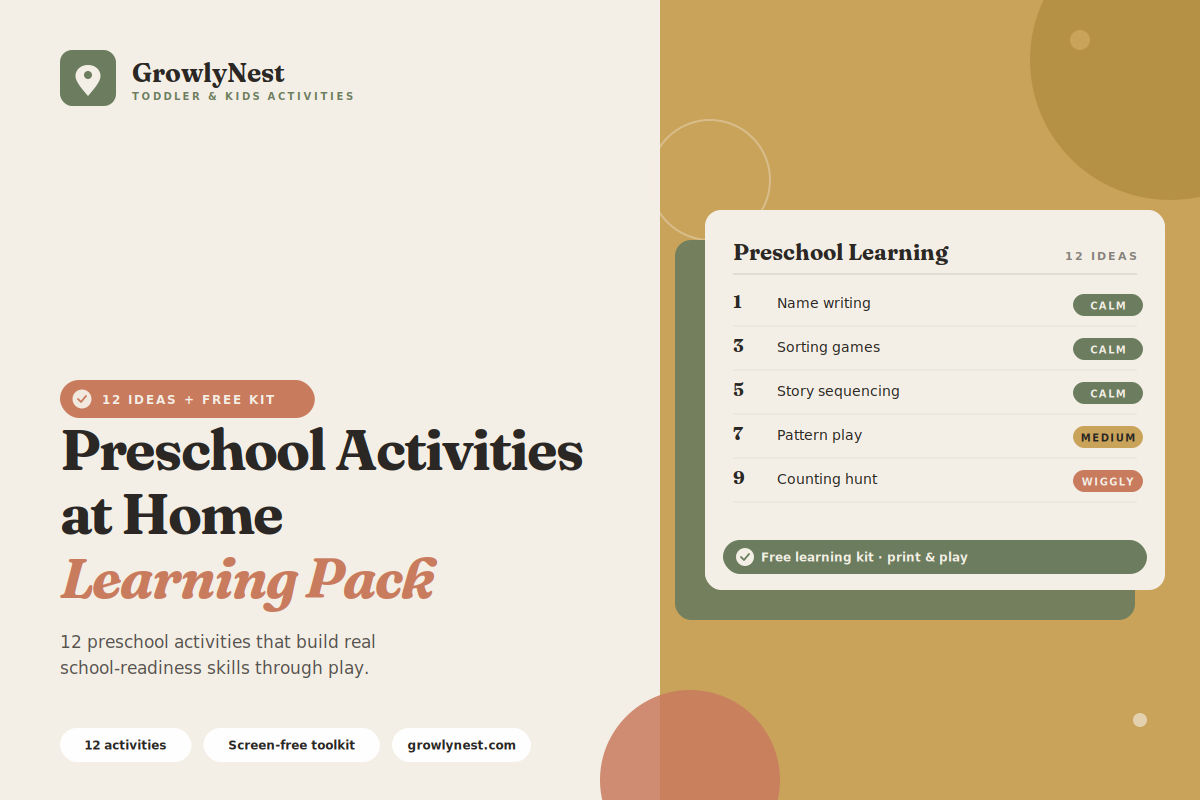
Includes the reassuring guide every parent needs — what toddlers actually need to learn before school, and what can wait — plus letters, numbers, shapes and fine-motor worksheets, hands-on activity cards, a “learning through the day” guide for everyday moments, and a simple skills-by-age reference.
Download the Free Learning Kit →Activities that build thinking and early academic skills
These playful activities build early literacy and numeracy without a worksheet in sight.
01. Name writing and letter play
Let your preschooler explore writing their name with chalk, magnetic letters, or a finger in sand. Their name is meaningful and motivating — a gentle, joyful entry into letters and writing.
02. Sorting and categorising games
Sort buttons, toys, or socks by colour, size, or type. Sorting builds the logical thinking, comparing, and classifying that underpin both maths and reading.
03. Story sequencing
After a story, talk through what happened first, next, and last, or order picture cards together. Sequencing builds comprehension, memory, and the narrative skills behind reading and writing.
04. Counting and number games in play
Count during play — steps in a game, blocks in a tower, snacks on a plate. Hands-on counting builds real number sense, which matters far more than reciting numbers.
Activities that build school-readiness foundations
These nurture the focus, fine motor skills, and independence school will ask for.
05. Fine motor and pre-writing play
Threading, playdough, cutting practice, and tong games build the hand strength behind holding a pencil. Strong little hands matter more before school than knowing how to write.
06. Focus and attention games
Simple games that build concentration — a puzzle, a memory game, an absorbing activity. Being able to stick with a task is a key, often-overlooked school-readiness skill.
07. Following instructions through play
Games with simple steps — a treasure hunt, a building challenge, a movement game — gently build the ability to listen to and follow instructions.
08. Independence and self-care practice
Let your preschooler practise dressing, tidying, pouring a drink, and managing their things. Independence and self-care confidence are genuinely important for the start of school.
Quietly wondering “am I doing enough?”
You almost certainly are — and the free Home Learning Starter Kit is here to reassure you. It includes a calm, anti-pressure guide to what toddlers really need before school and what can wait, letters, numbers, shapes and fine-motor worksheets, hands-on activity cards, a “learning through the day” guide, and a simple skills-by-age reference.
Get the Free Learning KitActivities that build curiosity, language, and confidence
These nurture the love of learning and the communication skills at the heart of school readiness.
09. Read together every day
Daily shared reading builds vocabulary, comprehension, focus, and a love of books — the single most valuable preschool activity, and one that feels like pure connection.
10. Open-ended creative play
Drawing, building, dressing up, small-world play — open-ended creativity builds imagination, problem-solving, and confidence. Resist over-directing it; the freedom is the point.
11. Conversation and rich talk
Talk with your preschooler throughout the day — real conversations, open questions, new words. Strong language is the foundation of all school learning, and it grows through talk.
12. Learning through everyday moments
Cooking, shopping, gardening, and chores are full of preschool learning — counting, measuring, sorting, vocabulary, sequencing. Embedding learning into real life is effective and effortless.
Tips for relaxed preschool at home
1. Prioritise play over academics
At preschool age, play is the work — it builds thinking, language, social skills, and creativity. Trust play, and resist the pressure to make learning look formal or academic.
2. Follow your child's pace and interests
There's no fixed timetable a preschooler must hit. Follow your child's developmental stage and genuine interests, and let those guide what you do and when.
3. Focus on the foundations, not early reading
Language, focus, fine motor skills, independence, and confidence matter far more than early reading or sums. Build the foundations and the academics follow naturally — early drilling can wait.
4. Keep it joyful and pressure-free
A child who associates learning with joy and curiosity carries that into school. A child who associates it with pressure does not. Keep preschool-at-home light, warm, and fun.
Frequently asked questions
What should a child know before starting school?
Far less academically than parents often think. The genuine foundations are language and communication, focus, fine motor strength, independence, social and emotional skills, and curiosity. Early reading and sums are not required and can wait.
Do I need a curriculum for preschool at home?
No. Preschool at home is about playful, everyday experiences that build school-readiness skills, not a formal curriculum. Following your child's interests and stage works better than any set programme.
Should my preschooler be reading or doing maths?
Most preschoolers are not, and that's completely normal. Reading and formal maths develop later and at very different rates. Building the foundations through play matters far more — the academics come in their own time.
Am I doing enough to prepare my child for school?
If you're talking, reading, and playing with your child and supporting their independence and curiosity, you are doing the things that genuinely matter. The pressure to do more academically is rarely warranted — connection and play are the real preparation.
How long should preschool-at-home activities last?
There's no set amount. Short, playful activities woven through a normal day are plenty. Much of the most valuable learning happens through free play, conversation, and everyday life rather than scheduled activities.
The Home Learning Starter Kit
Home learning, without the pressure
Everything in one free, reassuring download: the guide to what toddlers actually need before school and what can wait, letters, numbers, shapes and fine-motor worksheets, hands-on activity cards, a “learning through the day” guide for everyday moments, and a simple skills-by-age reference.
Download the Free Learning Kit →Free forever · No spam · Unsubscribe any time
From the GrowlyNest family — helping you nurture curious, confident learners through play, without the pressure.
You're getting — completely free
The Home Learning Pack
Here's how to get it
It arrives in 1–2 minutes — check your inbox now.
If you don't see the "Gift File" check your Promotions or Spam folder. Drag it to your main inbox so future emails reach you.
Loading Viewer...