
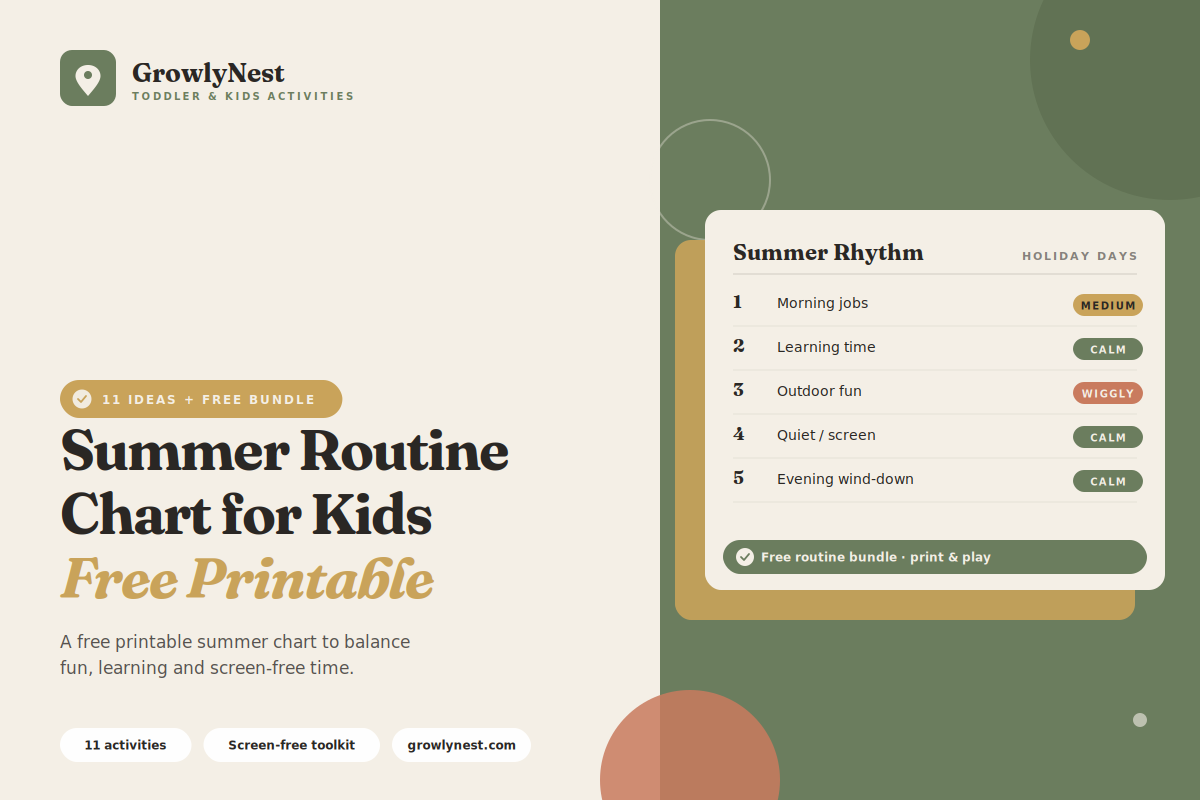
Summer · Ages 3–10 · Holiday Structure
The long summer holidays are wonderful — and, without any structure, can quickly tip into late starts, endless screens, bored children, and "there's nothing to do." A summer routine chart brings just enough rhythm to keep summer days happy and balanced, without turning the holidays into school. Here's a relaxed summer routine you can copy, plus how to make it work.
Why a summer routine chart helps
When the school routine vanishes for weeks, many children struggle more than parents expect — the loss of all structure leaves them unsettled, and summer days drift into screen-time battles and boredom. A summer routine chart gives children back the predictability they still need, while keeping the relaxed, free feeling that makes a summer a summer. It heads off the drift and gives each day a gentle, reassuring shape.
A summer routine also protects the things that easily slip over a long break — some learning to limit the "summer slide," outdoor time, screen balance, and a bit of helpful responsibility. The chart isn't about recreating school; it's a loose framework that holds the good stuff in place while leaving generous room for rest, play, and spontaneity. The strategies below help you keep that balance.
Free routine chart download
Get the Free Complete Kids Routine Chart Bundle
Includes the guide parents really need — how to get kids to actually follow the chart — plus morning, bedtime, after-school and chore charts, a routine builder worksheet to design your routine first, blank customisable versions, pre-reader picture cards, and travel and weekend troubleshooting.
Download the Free Routine Bundle →A sample summer routine for kids
Here is a relaxed summer rhythm to copy and adapt. Keep it looser than a school-day routine — these are gentle anchors, not a strict schedule.
01. A relaxed morning start
Allow a slower, later start than school days — a lie-in, an unhurried breakfast. The relaxed morning is part of what makes summer feel like a real break.
02. Morning jobs and getting dressed
A short, light set of morning jobs — getting dressed, a quick tidy, a simple chore. A little gentle structure stops the morning drifting.
03. A learning or quiet activity
A short slot of low-key learning — reading, a workbook page, a puzzle, a creative project. A little daily learning gently limits the summer slide without feeling like school.
04. Active and outdoor play
A generous block of active, outdoor play — the park, water play, the garden, a bike ride. Outdoor movement is the heart of a good summer day.
05. Lunch and quiet downtime
A calm, shared lunch followed by quiet time — reading, rest, or calm play. A downtime anchor in the heat of the day prevents over-tiredness and afternoon meltdowns.
06. Free play or a planned activity
Child-led free play, or the day's planned outing or project. Plenty of unstructured time belongs in summer — naming it on the chart makes it feel intentional.
07. Evening wind-down
A calm evening routine to close the day. Even relaxed summer days benefit from a consistent, settling end.
Struggling to get your child to follow the chart?
A chart on the wall is the easy part — getting kids to actually follow it is the real struggle. The free Complete Kids Routine Chart Bundle includes the step-by-step guide for exactly that, plus a routine builder worksheet, ready-made charts, pre-reader picture cards, and troubleshooting for travel and weekends.
Get the Free Routine BundleHow to make the summer routine work
A summer chart should make the holidays easier, not more rigid. These strategies keep it light and effective.
08. Keep it loose and flexible
A summer routine is a gentle rhythm, not a timetable. Hold a few anchors — a morning rhythm, outdoor time, mealtimes, downtime — and let everything else flex with the day.
09. Give screen time a clear slot
Rather than fielding constant requests all summer, put screen time in a clear, agreed slot on the chart. Visible and planned, it stops being a daily negotiation.
10. Plan some activities ahead
Decide a few outings and projects in advance so the chart has things to point to. A little planning prevents days drifting into screens by default.
11. Build the routine with your children
Let your children help shape the summer chart and choose some of the activities. Involvement builds enthusiasm and a sense of ownership over the summer.
Tips for a balanced summer
1. Balance fun, learning, and rest
A good summer day mixes active fun, a little learning, and genuine downtime. The chart helps you keep that balance rather than letting any one thing take over.
2. Protect downtime and free play
Resist over-scheduling the holidays. Children need unstructured time and rest to recharge — boredom often sparks their best imaginative play.
3. Keep mealtimes roughly consistent
Even with a looser summer, keeping meals at roughly their usual times keeps children's hunger, mood, and energy steady.
4. Use the chart against the summer slide
A small, daily learning slot — reading, a workbook page, a project — gently keeps skills ticking over across the long break, without feeling like school.
Frequently asked questions
Do kids need a routine in the summer holidays?
Children still benefit from predictability over summer, even though the routine should be much looser than during the school year. A gentle rhythm prevents the drift, boredom, and screen battles a completely unstructured summer can bring.
Won't a summer routine ruin the holiday feeling?
Not if it's kept loose. A summer chart should have later starts, lots of free play, and plenty of flexibility — just a few gentle anchors. It's a light rhythm, not a recreation of school.
How do I limit screen time over the summer?
Give screen time a clear, agreed slot on the summer chart so it's a known part of the day rather than a constant negotiation. Pair it with planned outdoor time and activities to keep it balanced.
What is the summer slide and how does a routine help?
The summer slide is the loss of some learning over the long break. A short daily learning slot on the summer chart — reading, a project, a workbook page — gently keeps skills ticking over without feeling like schoolwork.
How much should I plan versus leave free?
Aim for a balance — a few planned outings and activities to anchor the weeks, with generous free, unstructured time around them. Over-scheduling tires everyone; some boredom sparks great play.
The Complete Kids Routine Chart Bundle
A routine that actually sticks
Everything in one free download: the guide to getting kids to actually follow the chart, morning, bedtime, after-school and chore charts, a routine builder worksheet to design your routine first, blank customisable versions, pre-reader picture cards, and troubleshooting for travel and weekends.
Download the Free Routine Bundle →Free forever · No spam · Unsubscribe any time
From the GrowlyNest family — helping you build calm, predictable routines your children genuinely follow.
You're getting — completely free
The Complete Kids Routine Chart Bundle
Here's how to get it
It arrives in 1–2 minutes — check your inbox now.
If you don't see the "Gift File" check your Promotions or Spam folder. Drag it to your main inbox so future emails reach you.
Loading Viewer...